


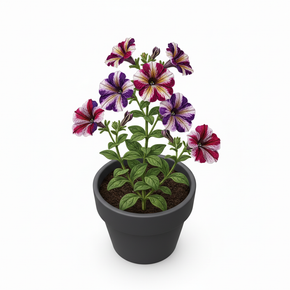



Ready to make your neighbors jealous? Our premium Hanging Petunia baskets are bursting with color and life, guaranteed to be the star of your outdoor space. These aren't just plants; they're waterfalls of vibrant, continuous blooms that demand attention. Incredibly full and easy to maintain, they are the perfect solution for instant, high-impact beauty. Don't wait – grab yours today and transform your home into a floral paradise!
Common Name: Petunia
Botanical Name: Petunia × atkinsiana
Arabic Name: بتونيا
Plant Variant: Hanging
Plant Color: Multicolor
Plant Country: Turkey
Family: Solanaceae
Petunia × atkinsiana is a hybrid species within the Solanaceae (nightshade) family. It is the most common garden petunia, having resulted from crosses between Petunia axillaris and Petunia integrifolia. These plants are classified as herbaceous perennials in tropical climates but are almost exclusively grown as annuals in temperate and Mediterranean regions.
While this specific variety originates from Turkey for commercial distribution, the genus Petunia is native to South America. Since their introduction to Europe and Asia in the 19th century, they have been widely naturalized and hybridized globally, becoming one of the most popular ornamental bedding and container plants in the world.
Hanging Petunias are characterized by their sprawling, decumbent stems that cascade over the edges of containers. The flowers are trumpet-shaped or funnel-shaped, featuring a velvety texture and a wide array of vibrant colors including purple, pink, white, red, and bicolors. The foliage consists of small, oval-shaped, hairy leaves that are slightly sticky to the touch.
The plant typically grows 6 to 12 inches (15–30 cm) in height but is prized for its trailing length, which can reach 2 to 4 feet (60–120 cm) in a single season depending on the cultivar and care provided. The flower diameter usually ranges from 2 to 4 inches.
Petunias require full sun to thrive and bloom profusely. They should receive at least 6 to 8 hours of direct sunlight daily. While they can tolerate partial shade, insufficient light will result in leggy growth and significantly fewer flowers.
Hanging baskets dry out much faster than ground-planted petunias. They require frequent watering, often daily during peak summer heat. The soil should be kept consistently moist but well-drained. Avoid overhead watering to prevent petal damage and fungal diseases; instead, water at the base of the plant.
A high-quality, lightweight, well-draining potting mix is essential for hanging varieties. A mix enriched with organic matter or peat moss helps retain necessary moisture while allowing excess water to escape. They prefer a slightly acidic to neutral soil pH (6.0 to 7.0).
Petunias prefer warm temperatures between 18°C and 25°C. They are sensitive to frost and will perish in freezing temperatures. They are generally adaptable to various humidity levels but perform best in moderate humidity with good air circulation to prevent powdery mildew.
Because they are "heavy feeders," petunias in hanging baskets need regular fertilization to maintain continuous blooms. Use a balanced, water-soluble fertilizer every 1 to 2 weeks throughout the growing season. High-phosphorus fertilizers can be used to specifically boost flower production.
The care level is considered easy to moderate. Regular "deadheading" (removing spent flowers) is vital to encourage the plant to produce new buds rather than seeds. If the plant becomes leggy or stops blooming in mid-summer, it can be pruned back by half to rejuvenate growth.
Petunias exhibit rapid growth during the spring and summer. They are most commonly propagated by seeds, though many modern hybrids are sterile and are grown from stem cuttings. For commercial use, tissue culture is also employed to ensure color consistency.
Susceptible to pests such as aphids, whiteflies, and slugs. Fungal issues like root rot can occur if soil remains waterlogged, and powdery mildew may appear in crowded, humid conditions with poor airflow. Budworms may also attack the developing flower buds.
Primarily used for ornamental purposes in hanging baskets, window boxes, and raised containers. They are excellent for providing instant vertical color and attracting pollinators like bees, butterflies, and hummingbirds to gardens and balconies.
Petunias are considered non-toxic to humans, dogs, and cats. They are safe to handle and grow in households with pets and children, making them an ideal choice for accessible garden spaces.
Ready to make your neighbors jealous? Our premium Hanging Petunia baskets are bursting with color and life, guaranteed to be the star of your outdoor space. These aren't just plants; they're waterfalls of vibrant, continuous blooms that demand attention. Incredibly full and easy to maintain, they are the perfect solution for instant, high-impact beauty. Don't wait – grab yours today and transform your home into a floral paradise!
Common Name: Petunia
Botanical Name: Petunia × atkinsiana
Arabic Name: بتونيا
Plant Variant: Hanging
Plant Color: Multicolor
Plant Country: Turkey
Family: Solanaceae
Petunia × atkinsiana is a hybrid species within the Solanaceae (nightshade) family. It is the most common garden petunia, having resulted from crosses between Petunia axillaris and Petunia integrifolia. These plants are classified as herbaceous perennials in tropical climates but are almost exclusively grown as annuals in temperate and Mediterranean regions.
While this specific variety originates from Turkey for commercial distribution, the genus Petunia is native to South America. Since their introduction to Europe and Asia in the 19th century, they have been widely naturalized and hybridized globally, becoming one of the most popular ornamental bedding and container plants in the world.
Hanging Petunias are characterized by their sprawling, decumbent stems that cascade over the edges of containers. The flowers are trumpet-shaped or funnel-shaped, featuring a velvety texture and a wide array of vibrant colors including purple, pink, white, red, and bicolors. The foliage consists of small, oval-shaped, hairy leaves that are slightly sticky to the touch.
The plant typically grows 6 to 12 inches (15–30 cm) in height but is prized for its trailing length, which can reach 2 to 4 feet (60–120 cm) in a single season depending on the cultivar and care provided. The flower diameter usually ranges from 2 to 4 inches.
Petunias require full sun to thrive and bloom profusely. They should receive at least 6 to 8 hours of direct sunlight daily. While they can tolerate partial shade, insufficient light will result in leggy growth and significantly fewer flowers.
Hanging baskets dry out much faster than ground-planted petunias. They require frequent watering, often daily during peak summer heat. The soil should be kept consistently moist but well-drained. Avoid overhead watering to prevent petal damage and fungal diseases; instead, water at the base of the plant.
A high-quality, lightweight, well-draining potting mix is essential for hanging varieties. A mix enriched with organic matter or peat moss helps retain necessary moisture while allowing excess water to escape. They prefer a slightly acidic to neutral soil pH (6.0 to 7.0).
Petunias prefer warm temperatures between 18°C and 25°C. They are sensitive to frost and will perish in freezing temperatures. They are generally adaptable to various humidity levels but perform best in moderate humidity with good air circulation to prevent powdery mildew.
Because they are "heavy feeders," petunias in hanging baskets need regular fertilization to maintain continuous blooms. Use a balanced, water-soluble fertilizer every 1 to 2 weeks throughout the growing season. High-phosphorus fertilizers can be used to specifically boost flower production.
The care level is considered easy to moderate. Regular "deadheading" (removing spent flowers) is vital to encourage the plant to produce new buds rather than seeds. If the plant becomes leggy or stops blooming in mid-summer, it can be pruned back by half to rejuvenate growth.
Petunias exhibit rapid growth during the spring and summer. They are most commonly propagated by seeds, though many modern hybrids are sterile and are grown from stem cuttings. For commercial use, tissue culture is also employed to ensure color consistency.
Susceptible to pests such as aphids, whiteflies, and slugs. Fungal issues like root rot can occur if soil remains waterlogged, and powdery mildew may appear in crowded, humid conditions with poor airflow. Budworms may also attack the developing flower buds.
Primarily used for ornamental purposes in hanging baskets, window boxes, and raised containers. They are excellent for providing instant vertical color and attracting pollinators like bees, butterflies, and hummingbirds to gardens and balconies.
Petunias are considered non-toxic to humans, dogs, and cats. They are safe to handle and grow in households with pets and children, making them an ideal choice for accessible garden spaces.
Take 20% off your first order
Enter the code below at checkout to get 20% off your first order


