


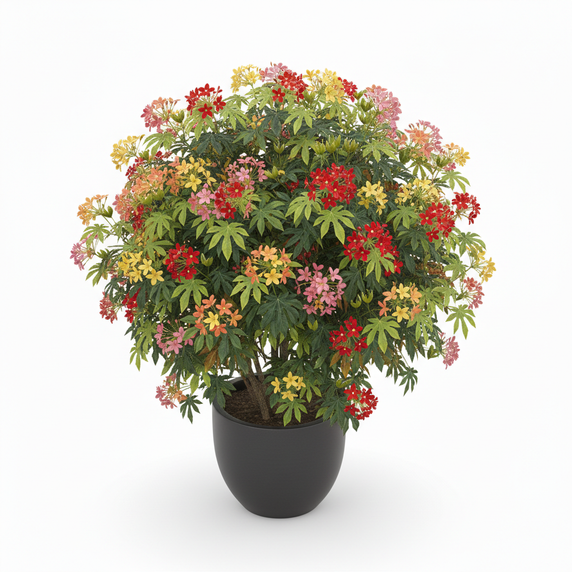





Ignite your space with the fiery, year-round blooms of the Jatropha Tree! This easy-care tropical beauty delivers a constant show of stunning red flowers, demanding little more than a sunny spot. It's the perfect statement piece for anyone seeking maximum visual impact with minimal fuss. Add a touch of perpetual summer to your home or garden today!
Common Name: Peregrina, Spicy Jatropha, Jatropha Tree
Botanical Name: Jatropha integerrima
Arabic Name: جاتروفا
Variant: Standard
Plant Color: Multicolor
Country of Origin: Netherlands
Kingdom: Plantae
Order: Malpighiales
Family: Euphorbiaceae
Genus: Jatropha
Species: J. integerrima
The Jatropha tree is native to the Caribbean, specifically Cuba and Hispaniola. It has been widely naturalized in tropical regions throughout the world, including Southeast Asia, Africa, and the southern United States (Florida), where it is prized for its ornamental value.
This evergreen shrub or small tree features glossy, dark green leaves that can vary in shape from oval to violin-shaped (lobed). It is most famous for its star-shaped, five-petaled flowers, which are typically a vivid scarlet red or deep pink, growing in branched clusters at the ends of the stems nearly year-round.
In outdoor landscapes, the Jatropha can reach heights of 10 to 15 feet with a spread of 6 to 10 feet. When grown in containers or as an indoor plant, it is easily maintained at a much smaller size (3 to 5 feet) through regular pruning.
Jatropha thrives in full sun to partial shade. For the most prolific blooming and dense foliage, it requires at least 6 hours of direct sunlight daily. Indoors, it should be placed in the brightest possible spot, such as a south-facing window.
The plant has moderate watering needs and is remarkably drought-tolerant once established. Water when the top inch of soil feels dry to the touch. Avoid overwatering or allowing the plant to sit in water, as it is susceptible to root rot.
It prefers well-draining soil with a neutral to slightly acidic pH. A high-quality potting mix blended with perlite or sand works well for container-grown specimens to ensure adequate drainage.
As a tropical species, it loves warm temperatures and high humidity. It is sensitive to frost and should be protected or moved indoors if temperatures drop below 50°F (10°C). It thrives in USDA Hardiness Zones 10-11.
Feed with a balanced, water-soluble fertilizer once a month during the growing season (spring and summer) to encourage continuous blooming. Reduce fertilization during the winter months.
The care level is considered easy to low-maintenance. Occasional pruning is recommended to maintain the desired shape and to remove spent flower clusters, which encourages new growth and further blooms.
Jatropha is a moderate to fast grower. It can be easily propagated through semi-hardwood cuttings taken in spring or summer, or by sowing seeds, although cuttings are the preferred method for maintaining the characteristics of the parent plant.
While generally pest-resistant, it can occasionally be affected by mites, scales, or mealybugs. Overwatering can lead to fungal issues and root rot. It is relatively resilient against most common plant diseases if provided with proper drainage and light.
Primarily used as an ornamental statement piece, the Jatropha is excellent for butterfly gardens as its flowers are highly attractive to pollinators. Its compact size when pruned makes it ideal for patios, decks, and bright indoor spaces like lobbies or entryways.
Warning: All parts of the Jatropha plant, particularly the seeds, are highly toxic if ingested by humans or pets. The milky sap can also cause skin irritation or dermatitis in sensitive individuals. It is recommended to wear gloves when pruning and keep the plant out of reach of children and animals.
Ignite your space with the fiery, year-round blooms of the Jatropha Tree! This easy-care tropical beauty delivers a constant show of stunning red flowers, demanding little more than a sunny spot. It's the perfect statement piece for anyone seeking maximum visual impact with minimal fuss. Add a touch of perpetual summer to your home or garden today!
Common Name: Peregrina, Spicy Jatropha, Jatropha Tree
Botanical Name: Jatropha integerrima
Arabic Name: جاتروفا
Variant: Standard
Plant Color: Multicolor
Country of Origin: Netherlands
Kingdom: Plantae
Order: Malpighiales
Family: Euphorbiaceae
Genus: Jatropha
Species: J. integerrima
The Jatropha tree is native to the Caribbean, specifically Cuba and Hispaniola. It has been widely naturalized in tropical regions throughout the world, including Southeast Asia, Africa, and the southern United States (Florida), where it is prized for its ornamental value.
This evergreen shrub or small tree features glossy, dark green leaves that can vary in shape from oval to violin-shaped (lobed). It is most famous for its star-shaped, five-petaled flowers, which are typically a vivid scarlet red or deep pink, growing in branched clusters at the ends of the stems nearly year-round.
In outdoor landscapes, the Jatropha can reach heights of 10 to 15 feet with a spread of 6 to 10 feet. When grown in containers or as an indoor plant, it is easily maintained at a much smaller size (3 to 5 feet) through regular pruning.
Jatropha thrives in full sun to partial shade. For the most prolific blooming and dense foliage, it requires at least 6 hours of direct sunlight daily. Indoors, it should be placed in the brightest possible spot, such as a south-facing window.
The plant has moderate watering needs and is remarkably drought-tolerant once established. Water when the top inch of soil feels dry to the touch. Avoid overwatering or allowing the plant to sit in water, as it is susceptible to root rot.
It prefers well-draining soil with a neutral to slightly acidic pH. A high-quality potting mix blended with perlite or sand works well for container-grown specimens to ensure adequate drainage.
As a tropical species, it loves warm temperatures and high humidity. It is sensitive to frost and should be protected or moved indoors if temperatures drop below 50°F (10°C). It thrives in USDA Hardiness Zones 10-11.
Feed with a balanced, water-soluble fertilizer once a month during the growing season (spring and summer) to encourage continuous blooming. Reduce fertilization during the winter months.
The care level is considered easy to low-maintenance. Occasional pruning is recommended to maintain the desired shape and to remove spent flower clusters, which encourages new growth and further blooms.
Jatropha is a moderate to fast grower. It can be easily propagated through semi-hardwood cuttings taken in spring or summer, or by sowing seeds, although cuttings are the preferred method for maintaining the characteristics of the parent plant.
While generally pest-resistant, it can occasionally be affected by mites, scales, or mealybugs. Overwatering can lead to fungal issues and root rot. It is relatively resilient against most common plant diseases if provided with proper drainage and light.
Primarily used as an ornamental statement piece, the Jatropha is excellent for butterfly gardens as its flowers are highly attractive to pollinators. Its compact size when pruned makes it ideal for patios, decks, and bright indoor spaces like lobbies or entryways.
Warning: All parts of the Jatropha plant, particularly the seeds, are highly toxic if ingested by humans or pets. The milky sap can also cause skin irritation or dermatitis in sensitive individuals. It is recommended to wear gloves when pruning and keep the plant out of reach of children and animals.




Take 20% off your first order
Enter the code below at checkout to get 20% off your first order