

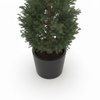





Make a statement of pure elegance. Our Juniper Standard Tree is the definitive choice for a sophisticated, structured landscape. Perfectly sculpted into a lush, evergreen globe atop a sturdy, clean trunk, this topiary delivers instant architectural impact and year-round curb appeal. Unlike fleeting seasonal flowers, its rich green presence is a constant, promising enduring beauty with minimal effort. Ideal for flanking doorways, defining patios, or as a standalone specimen, this hardy Juniper is your secret to a timeless, polished garden. Order now and introduce a touch of classic formality to your outdoor space.
Common Name: Juniper Standard Tree
Botanical Name: Juniperus chinensis
Former Name: Not available
Plant Type: Evergreen Conifer Topiary
Plant Code / SKU: PLT-1740
Alternative Names:
Chinese Juniper
جانبروس (Arabic)
Order: Pinales
Family: Cupressaceae
Genus: Juniperus
Native Range: Northeast Asia, including China, Mongolia, Japan, Korea, and the southeast of Russia.
Leaves/Foliage: Features dense, scale-like adult leaves that are typically a rich green to blue-green color. Juvenile foliage can be more awl-shaped or needle-like. As a 'standard', it is pruned into a globular or lollipop shape on a single, clear trunk.
Flowers/Cones: Produces small, inconspicuous male and female cones on separate plants (dioecious). Female plants produce fleshy, berry-like seed cones that are glaucous blue to purplish-black when mature.
Stem/Trunk: The 'standard' form features a single, straight, woody trunk that has been pruned clean of lower branches, supporting the sculpted foliage head. The bark is typically reddish-brown and peels in thin strips on mature plants.
Height: Typically maintained between 3 to 6 feet (0.9 to 1.8 m) for a standard topiary form, but can be trained to be smaller or larger.
Spread/Width: The foliage head is typically pruned to a width of 1.5 to 3 feet (0.45 to 0.9 m) to maintain its globe shape.
Trunk Height: Varies by design, but commonly ranges from 2 to 4 feet (0.6 to 1.2 m).
Prefers full sun, requiring at least 6-8 hours of direct sunlight per day to maintain its dense foliage and vigorous health. It can tolerate very light shade, but performance may decline, leading to sparser growth.
Once established, it is quite drought-tolerant. Water deeply and regularly during the first growing season to establish an extensive root system. Afterward, water occasionally, especially during extreme heat or prolonged dry spells. Allow soil to dry out between waterings. Container-grown specimens will require more frequent watering.
Soil Type: Thrives in a wide range of soils but performs best in well-drained soil. It is adaptable to various pH levels, from slightly acidic to slightly alkaline. Avoid heavy clay and waterlogged conditions, which can lead to root rot.
Potting Mix: For containers, use a high-quality potting mix designed for trees and shrubs, or a mix amended with perlite or sand to ensure excellent drainage.
Temperature: Very hardy and adaptable. It is typically suited for USDA Hardiness Zones 4 through 9, tolerating a wide range of temperatures from cold winters to hot summers.
Humidity: Tolerant of a wide range of humidity levels and is not sensitive to typical ambient humidity.
Junipers are not heavy feeders. If desired, apply a balanced, slow-release fertilizer formulated for evergreen trees and shrubs in the early spring before new growth begins. Avoid over-fertilizing, which can harm the plant.
Medium. The primary maintenance requirement is regular pruning or shearing to maintain the topiary shape. This is typically done once or twice a year, in late spring or early summer after the initial flush of growth. Otherwise, it is a very low-maintenance and robust plant.
Growth Rate: Slow to moderate, depending on the specific cultivar and growing conditions.
Propagation: Best propagated from semi-hardwood cuttings taken in late summer or early autumn. Propagation from seed is possible but is a slow process and may not produce a plant true to the parent form.
Pests: Can be susceptible to bagworms, spider mites, juniper scale, aphids, and webworms. Regular inspection can help catch infestations early.
Diseases: Prone to twig and tip blights (such as Phomopsis or Kabatina), especially in humid or wet conditions. Cedar-apple rust can also be an issue. Root rot can occur in poorly drained soils.
Highly valued for its architectural and formal aesthetic. Commonly used as a specimen plant, in containers on patios or balconies, to flank entryways and doors, or planted in pairs to create symmetry in a formal garden design. Provides year-round color and structure.
The foliage and berry-like cones contain compounds that are mildly toxic to humans, cats, and dogs if ingested in significant quantities, potentially causing gastrointestinal upset. The sap may also cause mild skin irritation or dermatitis in sensitive individuals. It is recommended to wear gloves when pruning.
Make a statement of pure elegance. Our Juniper Standard Tree is the definitive choice for a sophisticated, structured landscape. Perfectly sculpted into a lush, evergreen globe atop a sturdy, clean trunk, this topiary delivers instant architectural impact and year-round curb appeal. Unlike fleeting seasonal flowers, its rich green presence is a constant, promising enduring beauty with minimal effort. Ideal for flanking doorways, defining patios, or as a standalone specimen, this hardy Juniper is your secret to a timeless, polished garden. Order now and introduce a touch of classic formality to your outdoor space.
Common Name: Juniper Standard Tree
Botanical Name: Juniperus chinensis
Former Name: Not available
Plant Type: Evergreen Conifer Topiary
Plant Code / SKU: PLT-1740
Alternative Names:
Chinese Juniper
جانبروس (Arabic)
Order: Pinales
Family: Cupressaceae
Genus: Juniperus
Native Range: Northeast Asia, including China, Mongolia, Japan, Korea, and the southeast of Russia.
Leaves/Foliage: Features dense, scale-like adult leaves that are typically a rich green to blue-green color. Juvenile foliage can be more awl-shaped or needle-like. As a 'standard', it is pruned into a globular or lollipop shape on a single, clear trunk.
Flowers/Cones: Produces small, inconspicuous male and female cones on separate plants (dioecious). Female plants produce fleshy, berry-like seed cones that are glaucous blue to purplish-black when mature.
Stem/Trunk: The 'standard' form features a single, straight, woody trunk that has been pruned clean of lower branches, supporting the sculpted foliage head. The bark is typically reddish-brown and peels in thin strips on mature plants.
Height: Typically maintained between 3 to 6 feet (0.9 to 1.8 m) for a standard topiary form, but can be trained to be smaller or larger.
Spread/Width: The foliage head is typically pruned to a width of 1.5 to 3 feet (0.45 to 0.9 m) to maintain its globe shape.
Trunk Height: Varies by design, but commonly ranges from 2 to 4 feet (0.6 to 1.2 m).
Prefers full sun, requiring at least 6-8 hours of direct sunlight per day to maintain its dense foliage and vigorous health. It can tolerate very light shade, but performance may decline, leading to sparser growth.
Once established, it is quite drought-tolerant. Water deeply and regularly during the first growing season to establish an extensive root system. Afterward, water occasionally, especially during extreme heat or prolonged dry spells. Allow soil to dry out between waterings. Container-grown specimens will require more frequent watering.
Soil Type: Thrives in a wide range of soils but performs best in well-drained soil. It is adaptable to various pH levels, from slightly acidic to slightly alkaline. Avoid heavy clay and waterlogged conditions, which can lead to root rot.
Potting Mix: For containers, use a high-quality potting mix designed for trees and shrubs, or a mix amended with perlite or sand to ensure excellent drainage.
Temperature: Very hardy and adaptable. It is typically suited for USDA Hardiness Zones 4 through 9, tolerating a wide range of temperatures from cold winters to hot summers.
Humidity: Tolerant of a wide range of humidity levels and is not sensitive to typical ambient humidity.
Junipers are not heavy feeders. If desired, apply a balanced, slow-release fertilizer formulated for evergreen trees and shrubs in the early spring before new growth begins. Avoid over-fertilizing, which can harm the plant.
Medium. The primary maintenance requirement is regular pruning or shearing to maintain the topiary shape. This is typically done once or twice a year, in late spring or early summer after the initial flush of growth. Otherwise, it is a very low-maintenance and robust plant.
Growth Rate: Slow to moderate, depending on the specific cultivar and growing conditions.
Propagation: Best propagated from semi-hardwood cuttings taken in late summer or early autumn. Propagation from seed is possible but is a slow process and may not produce a plant true to the parent form.
Pests: Can be susceptible to bagworms, spider mites, juniper scale, aphids, and webworms. Regular inspection can help catch infestations early.
Diseases: Prone to twig and tip blights (such as Phomopsis or Kabatina), especially in humid or wet conditions. Cedar-apple rust can also be an issue. Root rot can occur in poorly drained soils.
Highly valued for its architectural and formal aesthetic. Commonly used as a specimen plant, in containers on patios or balconies, to flank entryways and doors, or planted in pairs to create symmetry in a formal garden design. Provides year-round color and structure.
The foliage and berry-like cones contain compounds that are mildly toxic to humans, cats, and dogs if ingested in significant quantities, potentially causing gastrointestinal upset. The sap may also cause mild skin irritation or dermatitis in sensitive individuals. It is recommended to wear gloves when pruning.
Take 20% off your first order
Enter the code below at checkout to get 20% off your first order