


Lucky Bamboo 'Spiral'
Invite prosperity and positive energy into your space with the iconic Spiral Lucky Bamboo. Not a true bamboo, this hardy Dracaena is incredibly easy to care for, thriving in just water and indirect light. Its elegant, twisted stalks make a stunning architectural statement on any desk, shelf, or tabletop. Perfect as a housewarming or good-luck gift, it's a living symbol of fortune that requires almost no effort to maintain.
1. Basic Identification
Common Name: Spiral Lucky Bamboo / Bamboo
Botanical Name: Dracaena sanderiana
Arabic Name: بامبو
Plant Variant: Spiral
Plant Color: Green
Family: Asparagaceae
2. Taxonomy & Classification
Lucky Bamboo belongs to the Kingdom Plantae, Order Asparagales, and the Family Asparagaceae. Despite its common name and bamboo-like appearance, it is taxonomically a member of the Dracaena genus and is more closely related to lilies than to true grasses (Poaceae) like actual bamboo.
3. Origin & Distribution
Native to Central Africa, specifically Cameroon, Dracaena sanderiana has been widely naturalized across Southeast Asia and China. It has become a global staple in indoor gardening and Feng Shui practices, symbolizing luck, wealth, and prosperity.
4. Visual Characteristics
The plant features fleshy, upright green stalks that are often trained into spiral, braided, or tiered shapes. It produces lance-shaped, slightly glossy green leaves that grow from the tops of the nodes. The "spiral" variant is achieved by rotating the plant relative to a light source during its growth phase.
5. Size & Dimensions
In indoor settings, stalks typically reach heights of 1 to 3 feet (30-90 cm). The leaves generally grow between 5 to 10 inches long. When grown in water, the size is often limited by the container, whereas in soil, the plant may grow slightly larger.
6. Light Requirements
Lucky Bamboo prefers moderate to bright indirect sunlight. It is highly adaptable and can tolerate lower light conditions, though its growth will slow. Direct sunlight should be avoided as it can easily scorch the delicate leaves.
7. Watering Needs
If grown in water, ensure the roots are always submerged and change the water every 7-10 days to prevent bacterial growth. It is sensitive to chlorine and fluoride found in tap water; using filtered, distilled, or rainwater is highly recommended.
8. Soil & Potting
This plant can be grown in a vase with water and pebbles for support, or in well-draining potting soil. If using soil, keep the medium slightly moist but never waterlogged to avoid root rot.
9. Temperature & Humidity
Thrives in warm environments with temperatures between 18°C and 32°C (65°F to 90°F). It prefers average to high humidity levels and should be kept away from cold drafts or air conditioning vents.
10. Fertilization
Lucky Bamboo requires very little feeding. If grown in water, a single drop of liquid fertilizer every month or two is sufficient. In soil, a balanced liquid fertilizer diluted to half-strength can be applied during the spring and summer.
11. Maintenance & Care Level
Care Level: Very Easy. Maintenance involves periodically cleaning the leaves of dust, removing any yellowing foliage, and ensuring the water remains fresh and clear.
12. Growth & Propagation
It is a slow to moderate grower. Propagation is easily achieved through stem cuttings. Simply cut a stalk below a node and place it in fresh water until new roots develop.
13. Common Problems
The most common issues are yellowing leaves, which can be caused by too much direct sun, high levels of fluoride/chlorine in the water, or over-fertilization. Soft, brown stems indicate root rot, usually due to stagnant or dirty water.
14. Benefits & Uses
Widely used as an air-purifying plant that helps remove toxins like benzene and formaldehyde from the air. In Feng Shui, it is used to balance the five elements and attract positive energy (Chi) into homes and offices.
15. Toxicity & Safety
Dracaena sanderiana is toxic to pets, including cats and dogs, if ingested. It contains saponins which can cause vomiting, drooling, and dilated pupils. It is generally considered safe for humans but should not be consumed.

Lucky Bamboo 'Spiral'
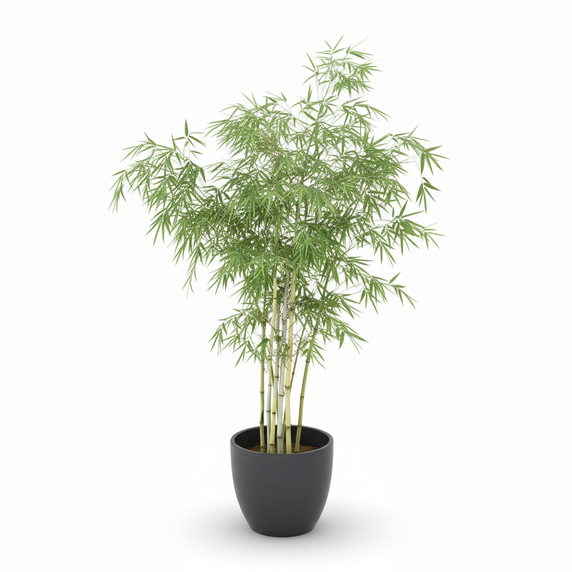
Invite prosperity and positive energy into your space with the iconic Spiral Lucky Bamboo. Not a true bamboo, this hardy Dracaena is incredibly easy to care for, thriving in just water and indirect light. Its elegant, twisted stalks make a stunning architectural statement on any desk, shelf, or tabletop. Perfect as a housewarming or good-luck gift, it's a living symbol of fortune that requires almost no effort to maintain.
1. Basic Identification
Common Name: Spiral Lucky Bamboo / Bamboo
Botanical Name: Dracaena sanderiana
Arabic Name: بامبو
Plant Variant: Spiral
Plant Color: Green
Family: Asparagaceae
2. Taxonomy & Classification
Lucky Bamboo belongs to the Kingdom Plantae, Order Asparagales, and the Family Asparagaceae. Despite its common name and bamboo-like appearance, it is taxonomically a member of the Dracaena genus and is more closely related to lilies than to true grasses (Poaceae) like actual bamboo.
3. Origin & Distribution
Native to Central Africa, specifically Cameroon, Dracaena sanderiana has been widely naturalized across Southeast Asia and China. It has become a global staple in indoor gardening and Feng Shui practices, symbolizing luck, wealth, and prosperity.
4. Visual Characteristics
The plant features fleshy, upright green stalks that are often trained into spiral, braided, or tiered shapes. It produces lance-shaped, slightly glossy green leaves that grow from the tops of the nodes. The "spiral" variant is achieved by rotating the plant relative to a light source during its growth phase.
5. Size & Dimensions
In indoor settings, stalks typically reach heights of 1 to 3 feet (30-90 cm). The leaves generally grow between 5 to 10 inches long. When grown in water, the size is often limited by the container, whereas in soil, the plant may grow slightly larger.
6. Light Requirements
Lucky Bamboo prefers moderate to bright indirect sunlight. It is highly adaptable and can tolerate lower light conditions, though its growth will slow. Direct sunlight should be avoided as it can easily scorch the delicate leaves.
7. Watering Needs
If grown in water, ensure the roots are always submerged and change the water every 7-10 days to prevent bacterial growth. It is sensitive to chlorine and fluoride found in tap water; using filtered, distilled, or rainwater is highly recommended.
8. Soil & Potting
This plant can be grown in a vase with water and pebbles for support, or in well-draining potting soil. If using soil, keep the medium slightly moist but never waterlogged to avoid root rot.
9. Temperature & Humidity
Thrives in warm environments with temperatures between 18°C and 32°C (65°F to 90°F). It prefers average to high humidity levels and should be kept away from cold drafts or air conditioning vents.
10. Fertilization
Lucky Bamboo requires very little feeding. If grown in water, a single drop of liquid fertilizer every month or two is sufficient. In soil, a balanced liquid fertilizer diluted to half-strength can be applied during the spring and summer.
11. Maintenance & Care Level
Care Level: Very Easy. Maintenance involves periodically cleaning the leaves of dust, removing any yellowing foliage, and ensuring the water remains fresh and clear.
12. Growth & Propagation
It is a slow to moderate grower. Propagation is easily achieved through stem cuttings. Simply cut a stalk below a node and place it in fresh water until new roots develop.
13. Common Problems
The most common issues are yellowing leaves, which can be caused by too much direct sun, high levels of fluoride/chlorine in the water, or over-fertilization. Soft, brown stems indicate root rot, usually due to stagnant or dirty water.
14. Benefits & Uses
Widely used as an air-purifying plant that helps remove toxins like benzene and formaldehyde from the air. In Feng Shui, it is used to balance the five elements and attract positive energy (Chi) into homes and offices.
15. Toxicity & Safety
Dracaena sanderiana is toxic to pets, including cats and dogs, if ingested. It contains saponins which can cause vomiting, drooling, and dilated pupils. It is generally considered safe for humans but should not be consumed.