

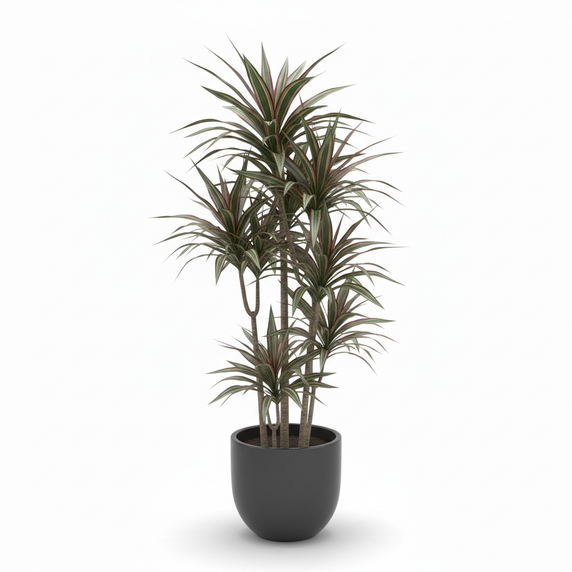





Elevate your space with the dramatic and effortless beauty of the Dracaena Marginata 'Bicolor'. With its slender, sword-like leaves edged in a vibrant crimson, this plant isn't just a decoration—it's a living sculpture. Not only does it make a bold style statement, but it also works hard to purify your air. Forget complex care routines; the Dragon Tree thrives on minimal attention, making it the perfect green companion for busy lives. Bring home this resilient, air-cleaning superstar today and breathe easier in style.
Common Name: Dragon Tree, Dracaena Bicolor, Madagascar Dragon Tree
Botanical Name: Dracaena marginata 'Bicolor'
Arabic Name: دراسينيا
Plant Variant: Bicolor
Plant Color: Multicolor (Green with red/pink margins)
Kingdom: Plantae
Clade: Tracheophytes
Clade: Angiosperms
Clade: Monocots
Order: Asparagales
Family: Asparagaceae
Genus: Dracaena
Species: Dracaena marginata (often classified as Dracaena reflexa var. angustifolia)
The Dracaena marginata is native to Madagascar. It has been naturalized in other subtropical regions and is widely cultivated globally as a popular indoor ornamental plant due to its durability and striking form.
This cultivar features long, slender, arching leaves that grow from woody stems (canes). The leaves are primarily green with distinct narrow red or pinkish stripes along the margins. As the plant grows, lower leaves drop, leaving a diamond-shaped pattern of scars on the attractive, greyish-brown trunk.
Indoors, the Dragon Tree typically reaches heights of 3 to 6 feet, though it can grow taller over several years. The leaves generally reach 12 to 24 inches in length and are very narrow, usually less than an inch wide.
Thrives in bright, indirect sunlight. While it can tolerate lower light levels, the vibrant red edges may fade, and growth will be significantly slower. Avoid direct, harsh sunlight, which can scorch the delicate leaves.
Dracaena marginata is relatively drought-tolerant. Allow the top 50% to 75% of the soil to dry out before watering thoroughly. It is sensitive to fluoride and salts often found in tap water, which can cause brown leaf tips; using filtered or distilled water is recommended.
Requires a well-draining potting mix to prevent root rot. A standard high-quality indoor potting soil amended with perlite or peat moss works well. Ensure the container has adequate drainage holes.
Prefers warm temperatures between 65°F and 80°F (18°C to 27°C). It can tolerate average household humidity but will thrive with occasional misting or the use of a humidifier, especially in dry winter months.
Feed with a balanced, water-soluble liquid fertilizer diluted to half-strength once a month during the growing season (spring and summer). Do not fertilize during the fall or winter when the plant's growth slows.
Care Level: Easy. Maintenance involves wiping the leaves with a damp cloth to remove dust and maintain photosynthesis. Pruning can be done to control height or encourage branching by cutting the top of the canes.
This is a slow-growing plant. It is easily propagated through stem cuttings. Cuttings can be rooted in either water or moist soil, usually taking several weeks to develop a robust root system.
Common issues include brown leaf tips (caused by fluoride in water, low humidity, or inconsistent watering). Pests may include spider mites, mealybugs, and scale, which can be treated with neem oil or insecticidal soap.
Recognized by NASA for its air-purifying qualities, it helps remove toxins such as formaldehyde, benzene, and trichloroethylene from the air. It is an excellent architectural plant for home décor, offices, and lobbies.
Toxic to pets. It contains saponins, which can cause vomiting, salivation, and dilated pupils in cats and dogs if ingested. It is generally non-toxic to humans but may cause mild stomach upset if leaves are consumed.
Elevate your space with the dramatic and effortless beauty of the Dracaena Marginata 'Bicolor'. With its slender, sword-like leaves edged in a vibrant crimson, this plant isn't just a decoration—it's a living sculpture. Not only does it make a bold style statement, but it also works hard to purify your air. Forget complex care routines; the Dragon Tree thrives on minimal attention, making it the perfect green companion for busy lives. Bring home this resilient, air-cleaning superstar today and breathe easier in style.
Common Name: Dragon Tree, Dracaena Bicolor, Madagascar Dragon Tree
Botanical Name: Dracaena marginata 'Bicolor'
Arabic Name: دراسينيا
Plant Variant: Bicolor
Plant Color: Multicolor (Green with red/pink margins)
Kingdom: Plantae
Clade: Tracheophytes
Clade: Angiosperms
Clade: Monocots
Order: Asparagales
Family: Asparagaceae
Genus: Dracaena
Species: Dracaena marginata (often classified as Dracaena reflexa var. angustifolia)
The Dracaena marginata is native to Madagascar. It has been naturalized in other subtropical regions and is widely cultivated globally as a popular indoor ornamental plant due to its durability and striking form.
This cultivar features long, slender, arching leaves that grow from woody stems (canes). The leaves are primarily green with distinct narrow red or pinkish stripes along the margins. As the plant grows, lower leaves drop, leaving a diamond-shaped pattern of scars on the attractive, greyish-brown trunk.
Indoors, the Dragon Tree typically reaches heights of 3 to 6 feet, though it can grow taller over several years. The leaves generally reach 12 to 24 inches in length and are very narrow, usually less than an inch wide.
Thrives in bright, indirect sunlight. While it can tolerate lower light levels, the vibrant red edges may fade, and growth will be significantly slower. Avoid direct, harsh sunlight, which can scorch the delicate leaves.
Dracaena marginata is relatively drought-tolerant. Allow the top 50% to 75% of the soil to dry out before watering thoroughly. It is sensitive to fluoride and salts often found in tap water, which can cause brown leaf tips; using filtered or distilled water is recommended.
Requires a well-draining potting mix to prevent root rot. A standard high-quality indoor potting soil amended with perlite or peat moss works well. Ensure the container has adequate drainage holes.
Prefers warm temperatures between 65°F and 80°F (18°C to 27°C). It can tolerate average household humidity but will thrive with occasional misting or the use of a humidifier, especially in dry winter months.
Feed with a balanced, water-soluble liquid fertilizer diluted to half-strength once a month during the growing season (spring and summer). Do not fertilize during the fall or winter when the plant's growth slows.
Care Level: Easy. Maintenance involves wiping the leaves with a damp cloth to remove dust and maintain photosynthesis. Pruning can be done to control height or encourage branching by cutting the top of the canes.
This is a slow-growing plant. It is easily propagated through stem cuttings. Cuttings can be rooted in either water or moist soil, usually taking several weeks to develop a robust root system.
Common issues include brown leaf tips (caused by fluoride in water, low humidity, or inconsistent watering). Pests may include spider mites, mealybugs, and scale, which can be treated with neem oil or insecticidal soap.
Recognized by NASA for its air-purifying qualities, it helps remove toxins such as formaldehyde, benzene, and trichloroethylene from the air. It is an excellent architectural plant for home décor, offices, and lobbies.
Toxic to pets. It contains saponins, which can cause vomiting, salivation, and dilated pupils in cats and dogs if ingested. It is generally non-toxic to humans but may cause mild stomach upset if leaves are consumed.



Take 20% off your first order
Enter the code below at checkout to get 20% off your first order


