

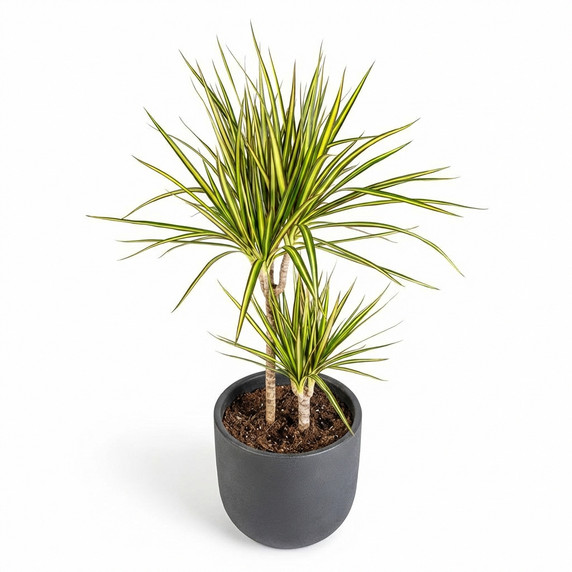





Transform any room with the architectural elegance of the Madagascar Dragon Tree. Standing tall at 170cm, its slender canes and vibrant, spiky foliage create a dramatic yet graceful statement. Not just a pretty face, this Dracaena is a NASA-approved air purifier, tirelessly working to remove toxins from your environment. Incredibly resilient and easy to care for, it's the perfect choice for both new plant parents and seasoned enthusiasts seeking a low-maintenance, high-impact green companion.
Common Name: Madagascar Dragon Tree
Botanical Name: Dracaena marginata
Arabic Name: دراسينيا
Plant Variant: Bon Bon
Plant Color: Green
Plant Country: Netherlands
Family: Asparagaceae
Kingdom: Plantae
Clade: Tracheophytes
Order: Asparagales
Family: Asparagaceae
Genus: Dracaena
Species: D. marginata
The Madagascar Dragon Tree is native to Madagascar. Due to its popularity as an ornamental plant, it is now widely cultivated in tropical regions around the world and is a staple in indoor gardening across Europe and North America.
This plant features stiff, upright canes that branch out to hold rosettes of long, narrow, sword-shaped leaves. The leaves are typically deep green with thin, reddish-maroon edges. The 'Bon Bon' variant often presents a more compact or uniquely clustered foliage arrangement compared to the wild type.
Indoors, Dracaena marginata can reach heights of 1.5 to 2.5 meters (this specimen stands at 170cm). It has a narrow profile, making it suitable for corners and vertical spaces without taking up significant floor width.
Thrives in bright, indirect light. While it can tolerate lower light conditions, the growth will be slower and the leaf color less vibrant. Avoid direct sunlight, which can scorch the leaves.
Moderate to low. Allow the top 50% of the soil to dry out before watering again. It is sensitive to overwatering and can develop root rot if left in soggy soil. It is also sensitive to fluoride in tap water, which may cause brown leaf tips.
Requires a well-draining potting mix. A standard indoor plant soil amended with perlite or coarse sand is ideal to ensure proper aeration and drainage.
Prefers warm temperatures between 18°C and 24°C (65°F–75°F). It can handle average indoor humidity but appreciates occasional misting or being placed in a slightly more humid environment.
Feed with a balanced liquid fertilizer diluted to half-strength once a month during the growing season (spring and summer). Do not fertilize in the winter months.
Low maintenance. Care involves wiping the leaves with a damp cloth to remove dust and maintain their ability to photosynthesize. Pruning can be done to manage height or encourage branching.
A slow-growing plant. Propagation is most successful through stem cuttings or air layering, typically performed in the spring or early summer.
Susceptible to spider mites, mealybugs, and scale insects. Brown leaf tips are a common issue usually caused by dry air, improper watering, or chemical sensitivity to tap water.
An excellent air purifier that removes toxins such as formaldehyde, benzene, and trichloroethylene from the air. Its architectural shape makes it a popular choice for modern interior design, offices, and lobbies.
Toxic to pets (cats and dogs) if ingested, as it contains saponins which can cause vomiting, drooling, and pupil dilation. It is generally not considered toxic to humans but may cause mild discomfort if consumed.
Transform any room with the architectural elegance of the Madagascar Dragon Tree. Standing tall at 170cm, its slender canes and vibrant, spiky foliage create a dramatic yet graceful statement. Not just a pretty face, this Dracaena is a NASA-approved air purifier, tirelessly working to remove toxins from your environment. Incredibly resilient and easy to care for, it's the perfect choice for both new plant parents and seasoned enthusiasts seeking a low-maintenance, high-impact green companion.
Common Name: Madagascar Dragon Tree
Botanical Name: Dracaena marginata
Arabic Name: دراسينيا
Plant Variant: Bon Bon
Plant Color: Green
Plant Country: Netherlands
Family: Asparagaceae
Kingdom: Plantae
Clade: Tracheophytes
Order: Asparagales
Family: Asparagaceae
Genus: Dracaena
Species: D. marginata
The Madagascar Dragon Tree is native to Madagascar. Due to its popularity as an ornamental plant, it is now widely cultivated in tropical regions around the world and is a staple in indoor gardening across Europe and North America.
This plant features stiff, upright canes that branch out to hold rosettes of long, narrow, sword-shaped leaves. The leaves are typically deep green with thin, reddish-maroon edges. The 'Bon Bon' variant often presents a more compact or uniquely clustered foliage arrangement compared to the wild type.
Indoors, Dracaena marginata can reach heights of 1.5 to 2.5 meters (this specimen stands at 170cm). It has a narrow profile, making it suitable for corners and vertical spaces without taking up significant floor width.
Thrives in bright, indirect light. While it can tolerate lower light conditions, the growth will be slower and the leaf color less vibrant. Avoid direct sunlight, which can scorch the leaves.
Moderate to low. Allow the top 50% of the soil to dry out before watering again. It is sensitive to overwatering and can develop root rot if left in soggy soil. It is also sensitive to fluoride in tap water, which may cause brown leaf tips.
Requires a well-draining potting mix. A standard indoor plant soil amended with perlite or coarse sand is ideal to ensure proper aeration and drainage.
Prefers warm temperatures between 18°C and 24°C (65°F–75°F). It can handle average indoor humidity but appreciates occasional misting or being placed in a slightly more humid environment.
Feed with a balanced liquid fertilizer diluted to half-strength once a month during the growing season (spring and summer). Do not fertilize in the winter months.
Low maintenance. Care involves wiping the leaves with a damp cloth to remove dust and maintain their ability to photosynthesize. Pruning can be done to manage height or encourage branching.
A slow-growing plant. Propagation is most successful through stem cuttings or air layering, typically performed in the spring or early summer.
Susceptible to spider mites, mealybugs, and scale insects. Brown leaf tips are a common issue usually caused by dry air, improper watering, or chemical sensitivity to tap water.
An excellent air purifier that removes toxins such as formaldehyde, benzene, and trichloroethylene from the air. Its architectural shape makes it a popular choice for modern interior design, offices, and lobbies.
Toxic to pets (cats and dogs) if ingested, as it contains saponins which can cause vomiting, drooling, and pupil dilation. It is generally not considered toxic to humans but may cause mild discomfort if consumed.



Take 20% off your first order
Enter the code below at checkout to get 20% off your first order