


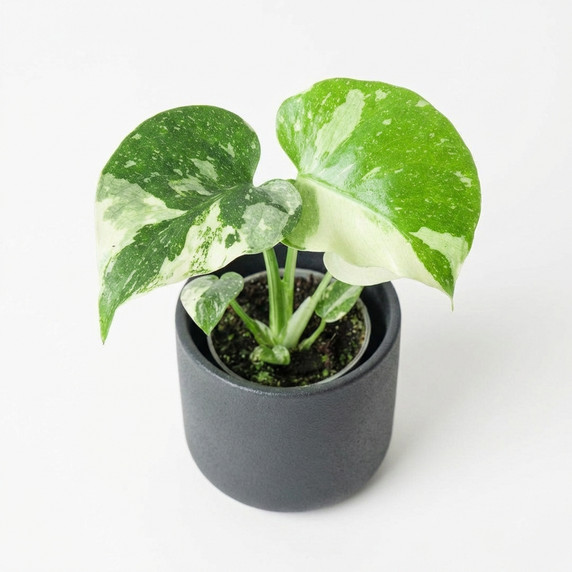





Bring home a true statement plant: Monstera 'Thai Constellation'. Its creamy, starry variegation turns every leaf into living artwork—perfect for modern homes, studios, and office desks. With bright filtered light and a well-draining aroid mix, this collector favorite rewards you with stunning new growth you’ll want to photograph every time.
Common Name: Thai Constellation Monstera
Plant Science Name: Monstera deliciosa 'Thai Constellation'
Plant Varient: Thai Constellation
Plant Color: Multicolor
Plant Country: Not mentioned
Arabic Name: يوفوربيا
Stems: Not available
Family: Araceae
The Monstera 'Thai Constellation' belongs to the Araceae family (aroids). It is a specific cultivar of the species Monstera deliciosa. Unlike some variegated plants that occur through random mutation, the Thai Constellation is a stable chimera created through tissue culture, ensuring its starry pattern persists across all leaves.
This plant does not exist in the wild in this specific form; it was originally developed in a tissue culture laboratory in Thailand. Its parent species, Monstera deliciosa, is native to the tropical rainforests of Southern Mexico and Central America.
It is characterized by large, heart-shaped leaves with deep lobes and fenestrations (holes). The defining feature is its "starry night" variegation, consisting of creamy-white to pale-yellow speckles, splashes, and occasional large blocks of color against a deep green background.
Indoors, it can reach heights of 6 to 10 feet when provided with a moss pole or support. Individual leaves can grow between 12 to 24 inches wide. It is a slightly more compact grower than the standard green deliciosa but can still occupy significant space.
Requires bright, indirect light to maintain its variegation and support growth. While it can tolerate medium light, its growth will slow and variegation may become less pronounced. Direct afternoon sun should be avoided as it can easily burn the white, non-chlorophyll parts of the leaves.
Water thoroughly when the top 50% of the soil has dried out. It is highly sensitive to overwatering and root rot. Ensure the pot has excellent drainage and never let the plant sit in standing water.
Thrives in a chunky, well-aerated "aroid mix." A combination of orchid bark, perlite, horticultural charcoal, and coco coir or peat moss is ideal to ensure the roots receive plenty of oxygen.
Prefers warm temperatures between 18°C and 27°C (65°F - 80°F). It thrives in high humidity environments (60% or higher) but is relatively adaptable to standard household humidity levels, though lower humidity may cause crispy leaf edges.
Feed with a balanced, water-soluble fertilizer formulated for houseplants once a month during the growing season (Spring and Summer). Reduce feeding during the dormant Winter months.
Moderate care level. While the variegation is stable and won't revert, the plant grows slower than non-variegated versions. Regular dusting of the leaves is necessary to help the plant photosynthesize efficiently.
Growth is moderate. Propagation is possible through stem cuttings, provided the cutting contains at least one node and an axillary bud. However, due to its tissue culture origins and slow growth, it is more challenging to propagate than standard Monsteras.
Most common issues include root rot from overwatering and browning of the variegated sections due to low humidity or light stress. It is susceptible to common pests like thrips, spider mites, and mealybugs.
Primarily used as a luxury ornamental centerpiece in interior design. Like other Monsteras, it has air-purifying qualities, helping to remove common toxins from the air while adding a tropical, sophisticated aesthetic to a room.
Contains calcium oxalate crystals, which are toxic if ingested. Keep away from pets (cats and dogs) and small children, as ingestion can cause mouth irritation, swelling, and digestive distress.
Bring home a true statement plant: Monstera 'Thai Constellation'. Its creamy, starry variegation turns every leaf into living artwork—perfect for modern homes, studios, and office desks. With bright filtered light and a well-draining aroid mix, this collector favorite rewards you with stunning new growth you’ll want to photograph every time.
Common Name: Thai Constellation Monstera
Plant Science Name: Monstera deliciosa 'Thai Constellation'
Plant Varient: Thai Constellation
Plant Color: Multicolor
Plant Country: Not mentioned
Arabic Name: يوفوربيا
Stems: Not available
Family: Araceae
The Monstera 'Thai Constellation' belongs to the Araceae family (aroids). It is a specific cultivar of the species Monstera deliciosa. Unlike some variegated plants that occur through random mutation, the Thai Constellation is a stable chimera created through tissue culture, ensuring its starry pattern persists across all leaves.
This plant does not exist in the wild in this specific form; it was originally developed in a tissue culture laboratory in Thailand. Its parent species, Monstera deliciosa, is native to the tropical rainforests of Southern Mexico and Central America.
It is characterized by large, heart-shaped leaves with deep lobes and fenestrations (holes). The defining feature is its "starry night" variegation, consisting of creamy-white to pale-yellow speckles, splashes, and occasional large blocks of color against a deep green background.
Indoors, it can reach heights of 6 to 10 feet when provided with a moss pole or support. Individual leaves can grow between 12 to 24 inches wide. It is a slightly more compact grower than the standard green deliciosa but can still occupy significant space.
Requires bright, indirect light to maintain its variegation and support growth. While it can tolerate medium light, its growth will slow and variegation may become less pronounced. Direct afternoon sun should be avoided as it can easily burn the white, non-chlorophyll parts of the leaves.
Water thoroughly when the top 50% of the soil has dried out. It is highly sensitive to overwatering and root rot. Ensure the pot has excellent drainage and never let the plant sit in standing water.
Thrives in a chunky, well-aerated "aroid mix." A combination of orchid bark, perlite, horticultural charcoal, and coco coir or peat moss is ideal to ensure the roots receive plenty of oxygen.
Prefers warm temperatures between 18°C and 27°C (65°F - 80°F). It thrives in high humidity environments (60% or higher) but is relatively adaptable to standard household humidity levels, though lower humidity may cause crispy leaf edges.
Feed with a balanced, water-soluble fertilizer formulated for houseplants once a month during the growing season (Spring and Summer). Reduce feeding during the dormant Winter months.
Moderate care level. While the variegation is stable and won't revert, the plant grows slower than non-variegated versions. Regular dusting of the leaves is necessary to help the plant photosynthesize efficiently.
Growth is moderate. Propagation is possible through stem cuttings, provided the cutting contains at least one node and an axillary bud. However, due to its tissue culture origins and slow growth, it is more challenging to propagate than standard Monsteras.
Most common issues include root rot from overwatering and browning of the variegated sections due to low humidity or light stress. It is susceptible to common pests like thrips, spider mites, and mealybugs.
Primarily used as a luxury ornamental centerpiece in interior design. Like other Monsteras, it has air-purifying qualities, helping to remove common toxins from the air while adding a tropical, sophisticated aesthetic to a room.
Contains calcium oxalate crystals, which are toxic if ingested. Keep away from pets (cats and dogs) and small children, as ingestion can cause mouth irritation, swelling, and digestive distress.

Take 20% off your first order
Enter the code below at checkout to get 20% off your first order