


Musaceae
Musa × paradisiaca
Bring the tropics home with the Banana Plant—lush, oversized leaves that transform any corner into a green getaway. Perfect as a floor statement plant for bright interiors and patios, it grows quickly and looks fuller with each new leaf. With regular watering, warmth, and a little feeding, Musa rewards you with dramatic, architectural greenery that elevates living rooms, receptions, and modern commercial spaces.
1. Basic Identification
Common Name: Banana Plant
Botanical Name: Musa × paradisiaca
Arabic Name: موز
Variant: Standard
Color: Natural
2. Taxonomy & Classification
Kingdom: Plantae
Order: Zingiberales
Family: Musaceae
Genus: Musa
Species: Musa × paradisiaca (a hybrid between Musa acuminata and Musa balbisiana).
3. Origin & Distribution
Originally native to Southeast Asia and the Indo-Malayan region. It is one of the oldest cultivated plants and is now distributed across all tropical and subtropical regions of the world for both ornamental and agricultural purposes.
4. Visual Characteristics
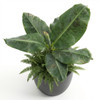
The plant features massive, paddle-shaped leaves with a vibrant green hue. The "trunk" is a pseudostem composed of tightly packed leaf bases. Leaves are broad and smooth, often developing natural splits over time as an adaptation to wind.
5. Size & Dimensions
When grown indoors, the Banana Plant typically reaches a height of 4 to 10 feet. Individual leaves can grow between 2 to 4 feet in length and up to a foot in width, depending on the maturity and container size.
6. Light Requirements
Thrives in bright light. It prefers at least 6 hours of direct sunlight or very bright indirect light. If kept indoors, placing it near a south-facing window is ideal to ensure vigorous growth.
7. Watering Needs
Requires frequent watering to keep the soil consistently moist but not soggy. During the growing season, water whenever the top inch of soil feels dry. Reduce watering slightly in the winter months.
8. Soil & Potting
Requires rich, well-draining soil with a slightly acidic to neutral pH. A mixture of high-quality potting soil, peat moss, and perlite or sand for drainage is recommended.
9. Temperature & Humidity
Prefers warm temperatures between 18°C and 30°C (65°F–85°F). As a tropical native, it requires high humidity levels (50% or higher). Use a humidifier or mist the leaves regularly in dry environments.
10. Fertilization
Banana plants are heavy feeders. Use a balanced, water-soluble fertilizer every 2 to 4 weeks during the spring and summer. Skip fertilization during the dormant winter period.
11. Maintenance & Care Level
Moderate care level. Maintenance involves wiping the large leaves with a damp cloth to remove dust and removing old, browned outer leaves to encourage new growth and maintain aesthetics.
12. Growth & Propagation
Fast-growing during the warm months. It propagates through "pups" or suckers that grow from the underground rhizome (corm). These can be separated from the parent plant once they have developed their own roots.
13. Common Problems
Watch for spider mites and mealybugs, especially in dry indoor air. Overwatering can lead to root rot, while low humidity can cause the leaf edges to turn brown and crispy.
14. Benefits & Uses
Highly valued for its dramatic, architectural foliage and ability to create an instant tropical atmosphere. It is popular in home décor, large lobbies, and as a centerpiece in indoor gardens.
15. Toxicity & Safety
Musa × paradisiaca is considered non-toxic to humans, dogs, and cats, making it a safe choice for households with children and pets.
Musa × paradisiaca

Bring the tropics home with the Banana Plant—lush, oversized leaves that transform any corner into a green getaway. Perfect as a floor statement plant for bright interiors and patios, it grows quickly and looks fuller with each new leaf. With regular watering, warmth, and a little feeding, Musa rewards you with dramatic, architectural greenery that elevates living rooms, receptions, and modern commercial spaces.
1. Basic Identification
Common Name: Banana Plant
Botanical Name: Musa × paradisiaca
Arabic Name: موز
Variant: Standard
Color: Natural
2. Taxonomy & Classification
Kingdom: Plantae
Order: Zingiberales
Family: Musaceae
Genus: Musa
Species: Musa × paradisiaca (a hybrid between Musa acuminata and Musa balbisiana).
3. Origin & Distribution
Originally native to Southeast Asia and the Indo-Malayan region. It is one of the oldest cultivated plants and is now distributed across all tropical and subtropical regions of the world for both ornamental and agricultural purposes.
4. Visual Characteristics
The plant features massive, paddle-shaped leaves with a vibrant green hue. The "trunk" is a pseudostem composed of tightly packed leaf bases. Leaves are broad and smooth, often developing natural splits over time as an adaptation to wind.
5. Size & Dimensions
When grown indoors, the Banana Plant typically reaches a height of 4 to 10 feet. Individual leaves can grow between 2 to 4 feet in length and up to a foot in width, depending on the maturity and container size.
6. Light Requirements
Thrives in bright light. It prefers at least 6 hours of direct sunlight or very bright indirect light. If kept indoors, placing it near a south-facing window is ideal to ensure vigorous growth.
7. Watering Needs
Requires frequent watering to keep the soil consistently moist but not soggy. During the growing season, water whenever the top inch of soil feels dry. Reduce watering slightly in the winter months.
8. Soil & Potting
Requires rich, well-draining soil with a slightly acidic to neutral pH. A mixture of high-quality potting soil, peat moss, and perlite or sand for drainage is recommended.
9. Temperature & Humidity
Prefers warm temperatures between 18°C and 30°C (65°F–85°F). As a tropical native, it requires high humidity levels (50% or higher). Use a humidifier or mist the leaves regularly in dry environments.
10. Fertilization
Banana plants are heavy feeders. Use a balanced, water-soluble fertilizer every 2 to 4 weeks during the spring and summer. Skip fertilization during the dormant winter period.
11. Maintenance & Care Level
Moderate care level. Maintenance involves wiping the large leaves with a damp cloth to remove dust and removing old, browned outer leaves to encourage new growth and maintain aesthetics.
12. Growth & Propagation
Fast-growing during the warm months. It propagates through "pups" or suckers that grow from the underground rhizome (corm). These can be separated from the parent plant once they have developed their own roots.
13. Common Problems
Watch for spider mites and mealybugs, especially in dry indoor air. Overwatering can lead to root rot, while low humidity can cause the leaf edges to turn brown and crispy.
14. Benefits & Uses
Highly valued for its dramatic, architectural foliage and ability to create an instant tropical atmosphere. It is popular in home décor, large lobbies, and as a centerpiece in indoor gardens.
15. Toxicity & Safety
Musa × paradisiaca is considered non-toxic to humans, dogs, and cats, making it a safe choice for households with children and pets.