

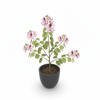





Transform your garden into a tropical paradise with the magnificent Orchid Tree (Bauhinia variegata)! Famous for its breathtakingly beautiful and fragrant flowers that resemble delicate orchids, this tree is a true showstopper. Its unique, camel-foot shaped leaves add year-round interest. Fast-growing and relatively low-maintenance, the Orchid Tree is the perfect choice for creating natural shade and spectacular spring color. Order yours today and watch your landscape come alive!
Common Name: Orchid Tree, Mountain Ebony, خف الجمل
Botanical Name: Bauhinia variegata
Plant Variant: Standard
Color: Natural
Country of Origin: India
Kingdom: Plantae
Order: Fabales
Family: Fabaceae
Genus: Bauhinia
Species: B. variegata
The Orchid Tree is native to South Asia and Southeast Asia, ranging from southern China through mainland Southeast Asia to India and Pakistan. It has been widely naturalized in tropical and subtropical regions across the globe.
Bauhinia variegata is a small to medium-sized deciduous tree. It features distinctive light green leaves that are deeply lobed at the apex and base, creating a twin-leaf or "camel-foot" appearance. The flowers are orchid-like, measuring 8–12 cm across, typically in shades of purple, pink, or white with streaks of magenta.
Under optimal conditions, this tree can reach heights of 10 to 12 meters (33 to 40 feet) with a spread of 3 to 6 meters. In domestic landscapes, it is often maintained at a smaller size through pruning.
Prefers full sun to achieve its best flowering potential but can tolerate partial shade. At least 6 hours of direct sunlight per day is recommended.
Moderately drought-tolerant once established. It requires regular watering during its first few years and during prolonged dry spells to maintain healthy growth and blooming.
Adapts well to a variety of soil types including sandy, loamy, and clay soils, provided they are well-draining. It prefers a slightly acidic to neutral pH. While typically grown in the ground, young specimens can be started in large pots.
Thrives in warm climates (USDA Zones 9-11). It is sensitive to severe frost, though it can survive brief periods of temperatures near freezing once mature. It enjoys moderate to high humidity.
Apply a balanced, slow-release fertilizer in early spring before the new growth begins. A second light application can be made in mid-summer.
Easy to maintain. Care level is low. Pruning should be done after the flowering season to shape the tree and remove any weak or dead branches.
This is a fast-growing tree. Propagation is most commonly achieved through seeds, which germinate readily, or via semi-hardwood cuttings.
Can be susceptible to leaf spot, mites, and aphids. Poorly drained soil can lead to root rot. It may also show signs of chlorosis (yellowing leaves) in highly alkaline soils.
Primarily used as an ornamental landscape tree for its striking floral display and unique foliage. It also provides excellent shade. In its native range, the flower buds are often pickled or used in traditional culinary dishes.
Bauhinia variegata is generally considered non-toxic to humans, cats, and dogs. It is safe for planting in areas frequented by pets and children.
Transform your garden into a tropical paradise with the magnificent Orchid Tree (Bauhinia variegata)! Famous for its breathtakingly beautiful and fragrant flowers that resemble delicate orchids, this tree is a true showstopper. Its unique, camel-foot shaped leaves add year-round interest. Fast-growing and relatively low-maintenance, the Orchid Tree is the perfect choice for creating natural shade and spectacular spring color. Order yours today and watch your landscape come alive!
Common Name: Orchid Tree, Mountain Ebony, خف الجمل
Botanical Name: Bauhinia variegata
Plant Variant: Standard
Color: Natural
Country of Origin: India
Kingdom: Plantae
Order: Fabales
Family: Fabaceae
Genus: Bauhinia
Species: B. variegata
The Orchid Tree is native to South Asia and Southeast Asia, ranging from southern China through mainland Southeast Asia to India and Pakistan. It has been widely naturalized in tropical and subtropical regions across the globe.
Bauhinia variegata is a small to medium-sized deciduous tree. It features distinctive light green leaves that are deeply lobed at the apex and base, creating a twin-leaf or "camel-foot" appearance. The flowers are orchid-like, measuring 8–12 cm across, typically in shades of purple, pink, or white with streaks of magenta.
Under optimal conditions, this tree can reach heights of 10 to 12 meters (33 to 40 feet) with a spread of 3 to 6 meters. In domestic landscapes, it is often maintained at a smaller size through pruning.
Prefers full sun to achieve its best flowering potential but can tolerate partial shade. At least 6 hours of direct sunlight per day is recommended.
Moderately drought-tolerant once established. It requires regular watering during its first few years and during prolonged dry spells to maintain healthy growth and blooming.
Adapts well to a variety of soil types including sandy, loamy, and clay soils, provided they are well-draining. It prefers a slightly acidic to neutral pH. While typically grown in the ground, young specimens can be started in large pots.
Thrives in warm climates (USDA Zones 9-11). It is sensitive to severe frost, though it can survive brief periods of temperatures near freezing once mature. It enjoys moderate to high humidity.
Apply a balanced, slow-release fertilizer in early spring before the new growth begins. A second light application can be made in mid-summer.
Easy to maintain. Care level is low. Pruning should be done after the flowering season to shape the tree and remove any weak or dead branches.
This is a fast-growing tree. Propagation is most commonly achieved through seeds, which germinate readily, or via semi-hardwood cuttings.
Can be susceptible to leaf spot, mites, and aphids. Poorly drained soil can lead to root rot. It may also show signs of chlorosis (yellowing leaves) in highly alkaline soils.
Primarily used as an ornamental landscape tree for its striking floral display and unique foliage. It also provides excellent shade. In its native range, the flower buds are often pickled or used in traditional culinary dishes.
Bauhinia variegata is generally considered non-toxic to humans, cats, and dogs. It is safe for planting in areas frequented by pets and children.




Take 20% off your first order
Enter the code below at checkout to get 20% off your first order