


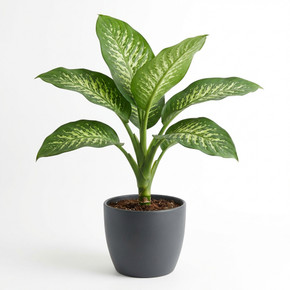


Bring instant tropical style indoors with Dieffenbachia seguine. Its bold green leaves brushed with creamy-yellow patterns brighten any room with minimal effort. Ideal for reception areas and living spaces, it performs beautifully in medium, indirect light and only needs watering when the top soil dries. A classic statement plant that looks premium all year round—just keep it out of reach of pets and small children.
Common Name: Dumb Cane
Botanical Name: Dieffenbachia seguine
Former Name: Not available
Plant Type: Foliage houseplant
Plant Code / SKU: PLT-0347
Alternative Names:
Leopard Lily
Tuft Root
ديفنباخيا
Order: Alismatales
Family: Araceae
Genus: Dieffenbachia
Native to the tropical Americas, including the Caribbean, Central America, and northern South America. Cultivated worldwide as an ornamental houseplant in subtropical and tropical regions.
Upright, cane-like stems bearing large, glossy, oval to lanceolate leaves. Foliage is deep green with irregular creamy-yellow variegation, often speckled or mottled. New leaves emerge rolled and pale before unfurling to full coloration.
Indoors typically reaches 2–5 ft (0.6–1.5 m) in height and 1–2 ft (0.3–0.6 m) in width. Individual leaves measure 6–12 in (15–30 cm) long and 3–6 in (8–15 cm) wide.
Thrives in bright, indirect light. Tolerates medium light but will lose vigor and variegation in low light. Direct sun can scorch leaves and cause bleaching.
Water thoroughly when the top 2–3 cm of soil is dry. Maintain evenly moist soil without waterlogging. Reduce watering frequency in winter; avoid allowing the soil to dry out completely.
Use a well-draining, peat-based potting mix enriched with perlite or bark. Ideal pH is 6.1–7.3. Repot every 2–3 years or when root-bound, selecting a container 1–2 inches larger in diameter.
Optimal temperature 65–75 °F (18–24 °C); minimum 60 °F (15 °C). Prefers high humidity (50–60%). Increase humidity using pebble trays, misting, or a humidifier to prevent brown leaf edges.
Feed with a balanced, water-soluble fertilizer (e.g., 20-20-20) at half strength every 4–6 weeks during spring and summer. Suspend feeding in fall and winter when growth slows.
Moderate care. Prune yellowing or damaged leaves at the base to maintain appearance. Monitor soil moisture and humidity. Inspect regularly for pests and diseases.
Propagate by stem cuttings or division. For cuttings, select a 4–6 in (10–15 cm) stem with at least two nodes, remove lower leaves, and root in water or moist potting mix. Division can be performed during repotting by separating clumps at the rhizome.
Overwatering can cause root rot and yellowing leaves. Brown leaf tips indicate low humidity or fluoride in water. Susceptible to spider mites, mealybugs, scale, and aphids. Cold drafts may cause leaf drop.
Valued for its striking foliage and architectural form in interior design. Known to help improve indoor air quality by filtering toxins such as formaldehyde and xylene. Ideal for offices, lobbies, and homes.
All parts contain insoluble calcium oxalate crystals and are toxic if ingested, causing oral irritation, drooling, nausea, vomiting, and difficulty swallowing. Handle with care, wear gloves, and keep out of reach of children and pets.
Bring instant tropical style indoors with Dieffenbachia seguine. Its bold green leaves brushed with creamy-yellow patterns brighten any room with minimal effort. Ideal for reception areas and living spaces, it performs beautifully in medium, indirect light and only needs watering when the top soil dries. A classic statement plant that looks premium all year round—just keep it out of reach of pets and small children.
Common Name: Dumb Cane
Botanical Name: Dieffenbachia seguine
Former Name: Not available
Plant Type: Foliage houseplant
Plant Code / SKU: PLT-0347
Alternative Names:
Leopard Lily
Tuft Root
ديفنباخيا
Order: Alismatales
Family: Araceae
Genus: Dieffenbachia
Native to the tropical Americas, including the Caribbean, Central America, and northern South America. Cultivated worldwide as an ornamental houseplant in subtropical and tropical regions.
Upright, cane-like stems bearing large, glossy, oval to lanceolate leaves. Foliage is deep green with irregular creamy-yellow variegation, often speckled or mottled. New leaves emerge rolled and pale before unfurling to full coloration.
Indoors typically reaches 2–5 ft (0.6–1.5 m) in height and 1–2 ft (0.3–0.6 m) in width. Individual leaves measure 6–12 in (15–30 cm) long and 3–6 in (8–15 cm) wide.
Thrives in bright, indirect light. Tolerates medium light but will lose vigor and variegation in low light. Direct sun can scorch leaves and cause bleaching.
Water thoroughly when the top 2–3 cm of soil is dry. Maintain evenly moist soil without waterlogging. Reduce watering frequency in winter; avoid allowing the soil to dry out completely.
Use a well-draining, peat-based potting mix enriched with perlite or bark. Ideal pH is 6.1–7.3. Repot every 2–3 years or when root-bound, selecting a container 1–2 inches larger in diameter.
Optimal temperature 65–75 °F (18–24 °C); minimum 60 °F (15 °C). Prefers high humidity (50–60%). Increase humidity using pebble trays, misting, or a humidifier to prevent brown leaf edges.
Feed with a balanced, water-soluble fertilizer (e.g., 20-20-20) at half strength every 4–6 weeks during spring and summer. Suspend feeding in fall and winter when growth slows.
Moderate care. Prune yellowing or damaged leaves at the base to maintain appearance. Monitor soil moisture and humidity. Inspect regularly for pests and diseases.
Propagate by stem cuttings or division. For cuttings, select a 4–6 in (10–15 cm) stem with at least two nodes, remove lower leaves, and root in water or moist potting mix. Division can be performed during repotting by separating clumps at the rhizome.
Overwatering can cause root rot and yellowing leaves. Brown leaf tips indicate low humidity or fluoride in water. Susceptible to spider mites, mealybugs, scale, and aphids. Cold drafts may cause leaf drop.
Valued for its striking foliage and architectural form in interior design. Known to help improve indoor air quality by filtering toxins such as formaldehyde and xylene. Ideal for offices, lobbies, and homes.
All parts contain insoluble calcium oxalate crystals and are toxic if ingested, causing oral irritation, drooling, nausea, vomiting, and difficulty swallowing. Handle with care, wear gloves, and keep out of reach of children and pets.

Take 20% off your first order
Enter the code below at checkout to get 20% off your first order