

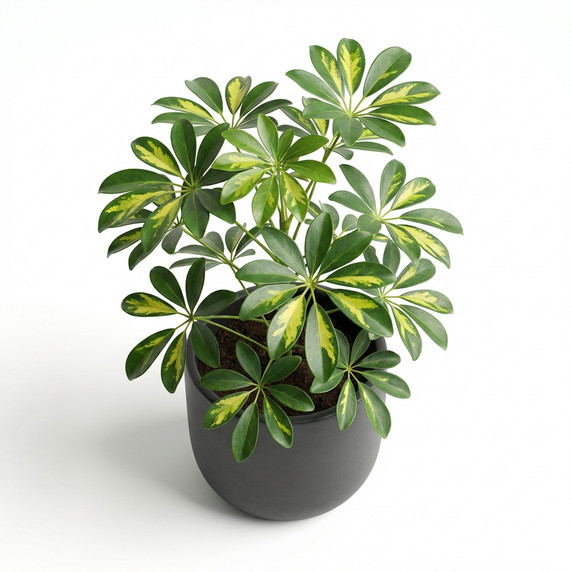


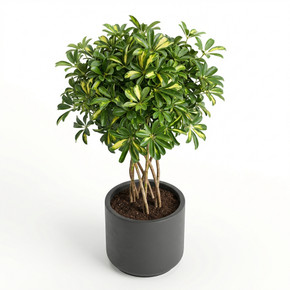
Bring instant, upscale greenery to any room with the Variegated Aralia (Dwarf Umbrella Tree). Its elegant, umbrella-like leaf clusters and creamy-yellow markings brighten corners and reception areas while staying wonderfully low-maintenance. Place it in bright, indirect light, water when the surface dries, and enjoy a tidy, architectural plant that looks premium all year.
Common Name: Variegated Aralia (Dwarf Umbrella Tree)
Botanical Name: Heptapleurum arboricola
Former Name: Schefflera arboricola
Plant Type: Foliage houseplant
Plant Code / SKU: PLT-0151
Alternative Names:
Dwarf Umbrella Tree
Variegated Schefflera
Dwarf Schefflera
Umbrella Tree
أراليا
Order: Apiales
Family: Araliaceae
Genus: Heptapleurum (formerly Schefflera)
Native to southern Taiwan and parts of Hainan island in China. Widely cultivated as an ornamental houseplant and naturalized in tropical and subtropical regions worldwide.
Evergreen shrub with slender, woody stems bearing clusters of glossy, palmate leaves. Each leaf has 7–16 narrow leaflets, variegated with creamy-white to yellow margins. New growth may exhibit pinkish tones before maturing to green and cream.
Indoors, typically reaches 1–2 m (3–6 ft) in height and 0.5–1 m (1.5–3 ft) in spread. Leaf clusters span 15–30 cm (6–12 in) across. Growth rate is moderate under optimal conditions.
Bright, indirect light ideal. Tolerates moderate shade but variegation may fade. Protect from harsh direct sun to prevent leaf scorch; east- or north-facing windows preferred.
Water when the top 2–3 cm (1 in) of soil feels dry. Maintain even moisture; avoid waterlogging and prolonged dryness. Reduce frequency slightly in winter.
Use a well-draining, peat-based potting mix amended with perlite or coarse sand. Ensure pots have drainage holes. Repot every 2–3 years or when root-bound.
Optimal temperature: 18–24 °C (65–75 °F). Tolerates minimum of 13 °C (55 °F). Prefers moderate to high humidity (50–70%). Increase humidity with pebble trays or humidifiers in dry indoor air.
Feed with a balanced liquid fertilizer (e.g., 10-10-10 NPK) diluted to half strength every 4–6 weeks during spring and summer. Cease fertilization in autumn and winter.
Easy to moderate care. Prune yearly to maintain shape and remove leggy growth. Rotate regularly to ensure even development. Wipe leaves occasionally to remove dust.
Propagate by semi-ripe stem cuttings, 10–15 cm long. Strip lower leaflets, place in water or moist potting mix, and root in 4–6 weeks. Seeds are rarely used.
Pests: spider mites, mealybugs, scale. Signs of overwatering: yellowing leaves, root rot. Low humidity: brown leaf tips. Variegation loss under low light. Treat pests with insecticidal soap and adjust care.
Attractive architectural foliage enhances indoor décor. Improves air quality by filtering pollutants. Compact size suits offices, reception areas, and living spaces.
Contains insoluble calcium oxalate crystals; toxic if ingested by pets and humans. May cause oral irritation, drooling, vomiting. Keep out of reach of children and animals.
Bring instant, upscale greenery to any room with the Variegated Aralia (Dwarf Umbrella Tree). Its elegant, umbrella-like leaf clusters and creamy-yellow markings brighten corners and reception areas while staying wonderfully low-maintenance. Place it in bright, indirect light, water when the surface dries, and enjoy a tidy, architectural plant that looks premium all year.
Common Name: Variegated Aralia (Dwarf Umbrella Tree)
Botanical Name: Heptapleurum arboricola
Former Name: Schefflera arboricola
Plant Type: Foliage houseplant
Plant Code / SKU: PLT-0151
Alternative Names:
Dwarf Umbrella Tree
Variegated Schefflera
Dwarf Schefflera
Umbrella Tree
أراليا
Order: Apiales
Family: Araliaceae
Genus: Heptapleurum (formerly Schefflera)
Native to southern Taiwan and parts of Hainan island in China. Widely cultivated as an ornamental houseplant and naturalized in tropical and subtropical regions worldwide.
Evergreen shrub with slender, woody stems bearing clusters of glossy, palmate leaves. Each leaf has 7–16 narrow leaflets, variegated with creamy-white to yellow margins. New growth may exhibit pinkish tones before maturing to green and cream.
Indoors, typically reaches 1–2 m (3–6 ft) in height and 0.5–1 m (1.5–3 ft) in spread. Leaf clusters span 15–30 cm (6–12 in) across. Growth rate is moderate under optimal conditions.
Bright, indirect light ideal. Tolerates moderate shade but variegation may fade. Protect from harsh direct sun to prevent leaf scorch; east- or north-facing windows preferred.
Water when the top 2–3 cm (1 in) of soil feels dry. Maintain even moisture; avoid waterlogging and prolonged dryness. Reduce frequency slightly in winter.
Use a well-draining, peat-based potting mix amended with perlite or coarse sand. Ensure pots have drainage holes. Repot every 2–3 years or when root-bound.
Optimal temperature: 18–24 °C (65–75 °F). Tolerates minimum of 13 °C (55 °F). Prefers moderate to high humidity (50–70%). Increase humidity with pebble trays or humidifiers in dry indoor air.
Feed with a balanced liquid fertilizer (e.g., 10-10-10 NPK) diluted to half strength every 4–6 weeks during spring and summer. Cease fertilization in autumn and winter.
Easy to moderate care. Prune yearly to maintain shape and remove leggy growth. Rotate regularly to ensure even development. Wipe leaves occasionally to remove dust.
Propagate by semi-ripe stem cuttings, 10–15 cm long. Strip lower leaflets, place in water or moist potting mix, and root in 4–6 weeks. Seeds are rarely used.
Pests: spider mites, mealybugs, scale. Signs of overwatering: yellowing leaves, root rot. Low humidity: brown leaf tips. Variegation loss under low light. Treat pests with insecticidal soap and adjust care.
Attractive architectural foliage enhances indoor décor. Improves air quality by filtering pollutants. Compact size suits offices, reception areas, and living spaces.
Contains insoluble calcium oxalate crystals; toxic if ingested by pets and humans. May cause oral irritation, drooling, vomiting. Keep out of reach of children and animals.


Take 20% off your first order
Enter the code below at checkout to get 20% off your first order