


Philodendron 'Golden Crocodile' 'Golden Crocodile'
Bring instant tropical character to your space with Philodendron 'Golden Crocodile'. Its dramatic long leaves and golden splashes look premium in minimalist interiors, while the care routine stays refreshingly simple. Place it in bright indirect light, water when the top soil dries, and enjoy a bold, modern statement plant that upgrades desks, living rooms, and reception areas in minutes.
1. Basic Identification
Common Name: Golden Crocodile Philodendron
Botanical Name: Philodendron 'Golden Crocodile'
Arabic Name: هيبسكس
Variety: Golden Crocodile
Family: Araceae
2. Taxonomy & Classification
The Philodendron 'Golden Crocodile' is a hybrid cultivar within the Araceae family. This genus is known for its diverse growth habits and foliage shapes. The 'Golden Crocodile' is often associated with the 'Ring of Fire' or 'Henderson's Pride' lineages but is distinguished by its specific lime-gold coloration and serrated leaf margins.
3. Origin & Distribution
While the parent species of most Philodendrons are native to the tropical rainforests of Central and South America, the 'Golden Crocodile' is a result of horticultural cultivation and hybridization. It is widely distributed globally as a popular ornamental houseplant.
4. Visual Characteristics
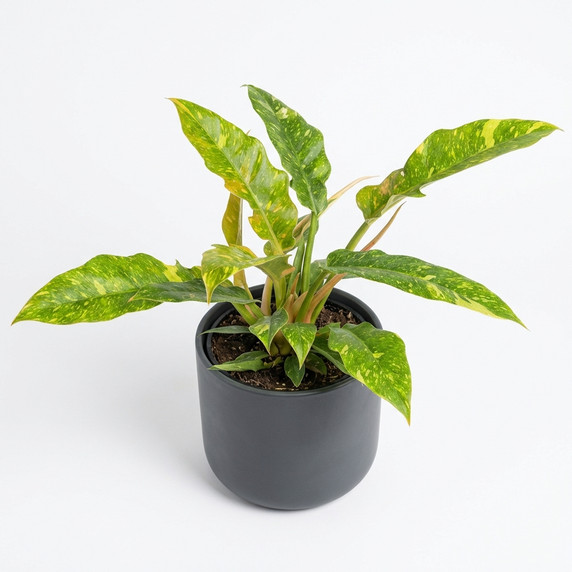
This plant features striking, elongated leaves with deeply serrated or "toothed" edges, resembling the snout of a crocodile. The foliage is a vibrant lime-green to golden-yellow color. New growth often emerges in a more intense yellow hue before maturing into a brighter green.
5. Size & Dimensions
Indoors, the Philodendron 'Golden Crocodile' typically reaches a height of 2 to 3 feet with a similar spread. Its leaves can grow quite large, often reaching 12 to 18 inches in length as the plant matures.
6. Light Requirements
It thrives in bright, indirect light. While it can tolerate medium light levels, its golden variegation is most prominent in brighter conditions. Direct sunlight should be avoided as it can scorch the delicate leaves.
7. Watering Needs
Water when the top 1–2 inches of soil have dried out. This plant prefers to stay slightly moist but is susceptible to root rot if left in standing water. Ensure the pot has adequate drainage.
8. Soil & Potting
Use a well-draining, chunky potting mix. An aroid-specific mix containing orchid bark, perlite, and peat moss or coco coir is ideal to ensure proper aeration for the roots.
9. Temperature & Humidity
Ideal temperatures range between 65°F and 85°F (18°C–29°C). It prefers higher humidity levels (50% or higher), which can be maintained through misting, a pebble tray, or a humidifier, though it can adapt to average household humidity.
10. Fertilization
Apply a balanced liquid fertilizer formulated for houseplants once a month during the growing season (spring and summer). Reduce or stop fertilization during the fall and winter months.
11. Maintenance & Care Level
The care level is considered easy to moderate. Maintenance involves regular dusting of the large leaves to ensure efficient photosynthesis and pruning any yellowing or damaged foliage to encourage healthy growth.
12. Growth & Propagation
It has a moderate growth rate. Propagation is most successful through stem cuttings that include at least one node. These cuttings can be rooted in water or directly in a moist potting medium.
13. Common Problems
Potential issues include root rot from overwatering and pests such as mealybugs, spider mites, or aphids. Yellowing leaves can indicate overwatering or insufficient light, while brown tips may suggest low humidity.
14. Benefits & Uses
Like many Philodendrons, it is an excellent air-purifying plant, capable of removing common household toxins from the air. It is highly valued for its architectural shape and vibrant color, making it a perfect statement piece for modern interior design.
15. Toxicity & Safety
Like other members of the Araceae family, this plant contains calcium oxalate crystals. It is toxic to both pets (cats and dogs) and humans if ingested, causing irritation of the mouth, throat, and digestive tract.
Philodendron 'Golden Crocodile' 'Golden Crocodile'
Bring instant tropical character to your space with Philodendron 'Golden Crocodile'. Its dramatic long leaves and golden splashes look premium in minimalist interiors, while the care routine stays refreshingly simple. Place it in bright indirect light, water when the top soil dries, and enjoy a bold, modern statement plant that upgrades desks, living rooms, and reception areas in minutes.
1. Basic Identification
Common Name: Golden Crocodile Philodendron
Botanical Name: Philodendron 'Golden Crocodile'
Arabic Name: هيبسكس
Variety: Golden Crocodile
Family: Araceae
2. Taxonomy & Classification
The Philodendron 'Golden Crocodile' is a hybrid cultivar within the Araceae family. This genus is known for its diverse growth habits and foliage shapes. The 'Golden Crocodile' is often associated with the 'Ring of Fire' or 'Henderson's Pride' lineages but is distinguished by its specific lime-gold coloration and serrated leaf margins.
3. Origin & Distribution
While the parent species of most Philodendrons are native to the tropical rainforests of Central and South America, the 'Golden Crocodile' is a result of horticultural cultivation and hybridization. It is widely distributed globally as a popular ornamental houseplant.
4. Visual Characteristics
This plant features striking, elongated leaves with deeply serrated or "toothed" edges, resembling the snout of a crocodile. The foliage is a vibrant lime-green to golden-yellow color. New growth often emerges in a more intense yellow hue before maturing into a brighter green.
5. Size & Dimensions
Indoors, the Philodendron 'Golden Crocodile' typically reaches a height of 2 to 3 feet with a similar spread. Its leaves can grow quite large, often reaching 12 to 18 inches in length as the plant matures.
6. Light Requirements
It thrives in bright, indirect light. While it can tolerate medium light levels, its golden variegation is most prominent in brighter conditions. Direct sunlight should be avoided as it can scorch the delicate leaves.
7. Watering Needs
Water when the top 1–2 inches of soil have dried out. This plant prefers to stay slightly moist but is susceptible to root rot if left in standing water. Ensure the pot has adequate drainage.
8. Soil & Potting
Use a well-draining, chunky potting mix. An aroid-specific mix containing orchid bark, perlite, and peat moss or coco coir is ideal to ensure proper aeration for the roots.
9. Temperature & Humidity
Ideal temperatures range between 65°F and 85°F (18°C–29°C). It prefers higher humidity levels (50% or higher), which can be maintained through misting, a pebble tray, or a humidifier, though it can adapt to average household humidity.
10. Fertilization
Apply a balanced liquid fertilizer formulated for houseplants once a month during the growing season (spring and summer). Reduce or stop fertilization during the fall and winter months.
11. Maintenance & Care Level
The care level is considered easy to moderate. Maintenance involves regular dusting of the large leaves to ensure efficient photosynthesis and pruning any yellowing or damaged foliage to encourage healthy growth.
12. Growth & Propagation
It has a moderate growth rate. Propagation is most successful through stem cuttings that include at least one node. These cuttings can be rooted in water or directly in a moist potting medium.
13. Common Problems
Potential issues include root rot from overwatering and pests such as mealybugs, spider mites, or aphids. Yellowing leaves can indicate overwatering or insufficient light, while brown tips may suggest low humidity.
14. Benefits & Uses
Like many Philodendrons, it is an excellent air-purifying plant, capable of removing common household toxins from the air. It is highly valued for its architectural shape and vibrant color, making it a perfect statement piece for modern interior design.
15. Toxicity & Safety
Like other members of the Araceae family, this plant contains calcium oxalate crystals. It is toxic to both pets (cats and dogs) and humans if ingested, causing irritation of the mouth, throat, and digestive tract.