


Picea pungens
Transform your landscape with the timeless elegance of the Blue Spruce. Its breathtaking silvery-blue foliage offers a stunning visual contrast year-round, making your garden stand out in every season. Exceptionally hardy and low-maintenance, this is the perfect tree to create a lasting natural legacy. Order now to add a touch of majestic mountain beauty to your outdoor space!
1. Basic Identification
Common Name: Blue Spruce
Botanical Name: Picea pungens
Former Name: Not available
Plant Type: Evergreen Coniferous Tree
Plant Code / SKU: PLT-1695
Alternative Names:
Colorado Spruce
Colorado Blue Spruce
Silver Spruce
بيسيا
2. Taxonomy & Classification
Order: Pinales
Family: Pinaceae
Genus: Picea
3. Origin & Distribution
Native Range: Native to the Rocky Mountains of North America, including the states of Colorado, Wyoming, Utah, Idaho, New Mexico, and Arizona.
Natural Habitat: Found in montane to subalpine zones, typically growing in moist locations along stream banks and in cool, sheltered valleys at altitudes of 6,000 to 11,000 feet (1,800–3,350 m).
4. Visual Characteristics
Foliage/Leaves: Stiff, sharp-pointed needles, approximately 1-1.5 inches long, arranged radially on the stems. The color is the main attraction, ranging from dull green to a striking silvery-blue or glaucous blue, which is caused by a waxy coating on the needles.
Flowers: Inconspicuous. Male flowers are reddish-purple and release yellow pollen in the spring. Female flowers are small, purplish, and typically found at the top of the tree.
Fruits/Seeds: Produces light brown, cylindrical seed cones that are 2-4 inches long. The cones have thin, flexible, papery scales with a wavy, irregular edge. Cones hang downwards from the branches.
Stem/Trunk: The trunk has grayish-brown bark that is thin and scaly on young trees, becoming thicker, ridged, and furrowed with age. The tree typically maintains a dense, narrow, pyramidal or conical shape.
5. Size & Dimensions
Mature Height: In landscape settings, typically grows to 30–60 feet (9–18 m). In its native habitat, it can reach heights of over 75 feet (23 m).
Mature Spread: 10–20 feet (3–6 m).
Growth Rate: Slow to medium, typically growing less than 12 inches per year.
6. Light Requirements
Sunlight Needs: Prefers full sun (6+ hours of direct sunlight per day). Full sun exposure is necessary for the best growth habit and the most vibrant blue needle color. It can tolerate light shade, but growth may be less dense and foliage color less intense.
7. Watering Needs
Watering Frequency: Requires regular watering, especially during its first few years to establish a deep root system. Once established, it is moderately drought-tolerant but performs best with consistent moisture. Water deeply when the top few inches of soil are dry. Avoid waterlogged conditions.
8. Soil & Potting
Soil Type: Adaptable to a variety of soils but prefers rich, moist, and well-drained soil. It can tolerate sandy and clay soils but struggles in consistently wet, poorly drained locations.
Soil pH: Prefers slightly acidic to neutral soil, with a pH range of 6.0 to 7.5.
9. Temperature & Humidity
Temperature Range: Extremely cold-hardy, thriving in USDA Hardiness Zones 2 through 7. It prefers cool climates and does not perform well in the high heat and humidity of southern climates (Zones 8 and above).
Humidity Preferences: Prefers average to low humidity. High humidity can increase its susceptibility to fungal diseases like needle cast.
10. Fertilization
Fertilizer Needs: Generally does not require supplemental fertilization if planted in reasonably fertile soil. If growth is poor or needles are yellowing, a slow-release, balanced fertilizer formulated for acid-loving trees and evergreens can be applied in early spring.
11. Maintenance & Care Level
Care Level: Low. It is a very hardy and low-maintenance tree once established.
Pruning: Little to no pruning is required. Pruning can be done to remove dead, broken, or diseased branches. Avoid cutting the central leader. Heavy pruning can permanently alter its natural, symmetrical conical shape.
12. Growth & Propagation
Propagation Methods: The species is most commonly propagated from seed. However, specific blue-colored cultivars do not come true from seed and must be propagated by grafting onto seedling rootstock to preserve their unique coloration and form.
13. Common Problems
Pests: Susceptible to several pests, including spruce spider mites (especially in hot, dry conditions), pine needle scale, spruce budworm, and Cooley spruce gall adelgid, which causes cone-like galls on the tips of new growth.
Diseases: Prone to fungal diseases, particularly in humid climates or when stressed. Common issues include Cytospora canker, which causes branch dieback, and Rhizosphaera needle cast, which causes needles to turn purplish-brown and drop prematurely.
14. Benefits & Uses
Landscape Uses: Highly valued as a specimen tree in residential and commercial landscapes due to its striking color and classic conical shape. It is also used effectively in privacy screens, windbreaks, and as a living Christmas tree.
Environmental Benefits: Provides year-round shelter for birds and other wildlife. Its dense structure makes it an excellent nesting site.
15. Toxicity & Safety
Toxicity to Humans: Non-toxic if ingested. However, the needles are very sharp and stiff, which can cause skin irritation or minor injuries upon contact.
Toxicity to Pets: Considered non-toxic to dogs, cats, and horses. Ingestion of a large number of needles could potentially cause mild gastrointestinal upset, and the sharp needles pose a risk of physical injury to the mouth and digestive tract.
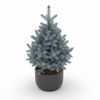
Picea pungens

Transform your landscape with the timeless elegance of the Blue Spruce. Its breathtaking silvery-blue foliage offers a stunning visual contrast year-round, making your garden stand out in every season. Exceptionally hardy and low-maintenance, this is the perfect tree to create a lasting natural legacy. Order now to add a touch of majestic mountain beauty to your outdoor space!
1. Basic Identification
Common Name: Blue Spruce
Botanical Name: Picea pungens
Former Name: Not available
Plant Type: Evergreen Coniferous Tree
Plant Code / SKU: PLT-1695
Alternative Names:
Colorado Spruce
Colorado Blue Spruce
Silver Spruce
بيسيا
2. Taxonomy & Classification
Order: Pinales
Family: Pinaceae
Genus: Picea
3. Origin & Distribution
Native Range: Native to the Rocky Mountains of North America, including the states of Colorado, Wyoming, Utah, Idaho, New Mexico, and Arizona.
Natural Habitat: Found in montane to subalpine zones, typically growing in moist locations along stream banks and in cool, sheltered valleys at altitudes of 6,000 to 11,000 feet (1,800–3,350 m).
4. Visual Characteristics
Foliage/Leaves: Stiff, sharp-pointed needles, approximately 1-1.5 inches long, arranged radially on the stems. The color is the main attraction, ranging from dull green to a striking silvery-blue or glaucous blue, which is caused by a waxy coating on the needles.
Flowers: Inconspicuous. Male flowers are reddish-purple and release yellow pollen in the spring. Female flowers are small, purplish, and typically found at the top of the tree.
Fruits/Seeds: Produces light brown, cylindrical seed cones that are 2-4 inches long. The cones have thin, flexible, papery scales with a wavy, irregular edge. Cones hang downwards from the branches.
Stem/Trunk: The trunk has grayish-brown bark that is thin and scaly on young trees, becoming thicker, ridged, and furrowed with age. The tree typically maintains a dense, narrow, pyramidal or conical shape.
5. Size & Dimensions
Mature Height: In landscape settings, typically grows to 30–60 feet (9–18 m). In its native habitat, it can reach heights of over 75 feet (23 m).
Mature Spread: 10–20 feet (3–6 m).
Growth Rate: Slow to medium, typically growing less than 12 inches per year.
6. Light Requirements
Sunlight Needs: Prefers full sun (6+ hours of direct sunlight per day). Full sun exposure is necessary for the best growth habit and the most vibrant blue needle color. It can tolerate light shade, but growth may be less dense and foliage color less intense.
7. Watering Needs
Watering Frequency: Requires regular watering, especially during its first few years to establish a deep root system. Once established, it is moderately drought-tolerant but performs best with consistent moisture. Water deeply when the top few inches of soil are dry. Avoid waterlogged conditions.
8. Soil & Potting
Soil Type: Adaptable to a variety of soils but prefers rich, moist, and well-drained soil. It can tolerate sandy and clay soils but struggles in consistently wet, poorly drained locations.
Soil pH: Prefers slightly acidic to neutral soil, with a pH range of 6.0 to 7.5.
9. Temperature & Humidity
Temperature Range: Extremely cold-hardy, thriving in USDA Hardiness Zones 2 through 7. It prefers cool climates and does not perform well in the high heat and humidity of southern climates (Zones 8 and above).
Humidity Preferences: Prefers average to low humidity. High humidity can increase its susceptibility to fungal diseases like needle cast.
10. Fertilization
Fertilizer Needs: Generally does not require supplemental fertilization if planted in reasonably fertile soil. If growth is poor or needles are yellowing, a slow-release, balanced fertilizer formulated for acid-loving trees and evergreens can be applied in early spring.
11. Maintenance & Care Level
Care Level: Low. It is a very hardy and low-maintenance tree once established.
Pruning: Little to no pruning is required. Pruning can be done to remove dead, broken, or diseased branches. Avoid cutting the central leader. Heavy pruning can permanently alter its natural, symmetrical conical shape.
12. Growth & Propagation
Propagation Methods: The species is most commonly propagated from seed. However, specific blue-colored cultivars do not come true from seed and must be propagated by grafting onto seedling rootstock to preserve their unique coloration and form.
13. Common Problems
Pests: Susceptible to several pests, including spruce spider mites (especially in hot, dry conditions), pine needle scale, spruce budworm, and Cooley spruce gall adelgid, which causes cone-like galls on the tips of new growth.
Diseases: Prone to fungal diseases, particularly in humid climates or when stressed. Common issues include Cytospora canker, which causes branch dieback, and Rhizosphaera needle cast, which causes needles to turn purplish-brown and drop prematurely.
14. Benefits & Uses
Landscape Uses: Highly valued as a specimen tree in residential and commercial landscapes due to its striking color and classic conical shape. It is also used effectively in privacy screens, windbreaks, and as a living Christmas tree.
Environmental Benefits: Provides year-round shelter for birds and other wildlife. Its dense structure makes it an excellent nesting site.
15. Toxicity & Safety
Toxicity to Humans: Non-toxic if ingested. However, the needles are very sharp and stiff, which can cause skin irritation or minor injuries upon contact.
Toxicity to Pets: Considered non-toxic to dogs, cats, and horses. Ingestion of a large number of needles could potentially cause mild gastrointestinal upset, and the sharp needles pose a risk of physical injury to the mouth and digestive tract.