

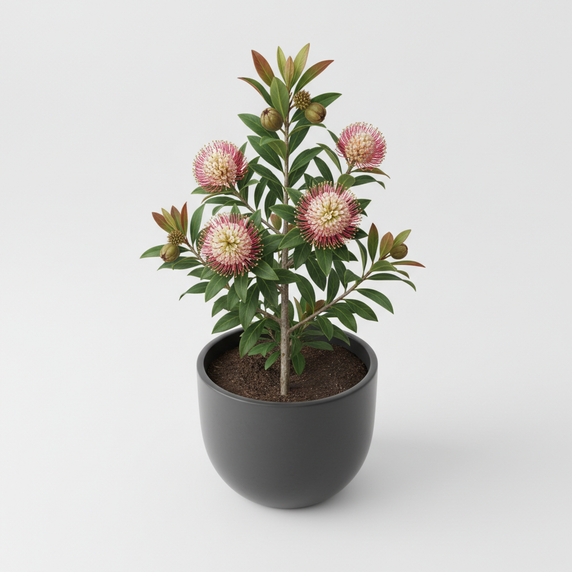
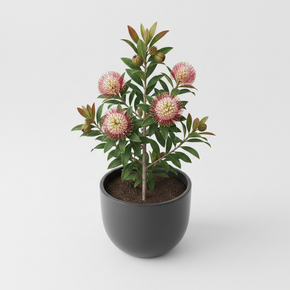
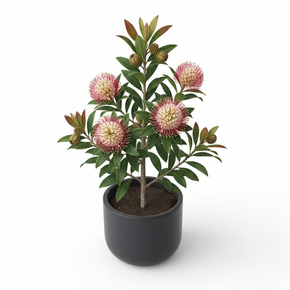



Transform your garden with the breathtaking Pincushion Hakea! A true masterpiece of nature, this Australian native captivates with its unique, globe-like crimson and cream flowers that bloom when little else does. Not just a pretty face, it’s incredibly tough, drought-tolerant, and a magnet for beautiful nectar-feeding birds. Add a touch of the Australian bush to your landscape and enjoy spectacular, low-maintenance color year after year.
Common Name: Pincushion Hakea, Kodjet
Botanical Name: Hakea laurina
Arabic Name: جاي استرالي
Family: Proteaceae
Plant Variant: Standard
Plant Color: Multicolor (Crimson and Cream)
Hakea laurina is a member of the Proteaceae family, which is known for its distinctive and often spectacular inflorescences. The genus Hakea contains approximately 150 species of shrubs and trees, all of which are endemic to Australia. The species name 'laurina' refers to its laurel-like leaves.
This species is native to the southwest of Western Australia, occurring naturally between Esperance and Perth. Due to its ornamental value, it has been widely introduced to other Mediterranean climates across Australia, the Mediterranean basin, and parts of California.
The Pincushion Hakea is famous for its "pincushion" flowers—globular clusters of deep red to crimson flowers tipped with long, pale cream or white styles. The foliage consists of leathery, simple, lance-shaped leaves with prominent longitudinal veins. The bark is smooth and grey, becoming slightly fissured with age.
Typically growing as a large shrub or small upright tree, it reaches heights between 2.5 and 6 meters (8 to 20 feet) and a width of 3 to 5 meters. Its size can be managed through careful pruning.
It performs best in full sun, which promotes the most prolific flowering. While it can tolerate very light shade, insufficient light will result in leggy growth and fewer blooms.
Extremely drought-tolerant once established. It requires minimal watering and is highly susceptible to root rot if the soil remains waterlogged. It is best suited for "dry-summer" climates.
Requires very well-drained soil. It thrives in sandy, loamy, or gravelly soils that are neutral to slightly acidic. Avoid heavy clay soils. While usually grown in the ground, younger specimens can be kept in large, well-draining pots using a native-specific potting mix.
Prefers warm, dry summers and cool, moist winters. It is frost-tolerant once mature but can be sensitive to high humidity, which increases the risk of fungal leaf diseases.
Requires very little fertilization. Like many Proteaceae, it is sensitive to phosphorus. Use only low-phosphorus fertilizers specifically formulated for Australian native plants if needed.
Maintenance is low. A light pruning after the flowering season helps maintain a bushy habit and prevents the plant from becoming too woody or sparse.
It is a relatively fast-growing species. Propagation is primarily achieved through seeds, which are housed in woody valves. Cuttings can be used but are generally considered difficult to strike.
The most common issue is Phytophthora (root rot) caused by poor drainage or overwatering. Fungal spots may appear on leaves in humid environments. It is generally resistant to most pests.
An excellent choice for xeriscaping, coastal gardens, and bird-friendly landscapes. It serves as a vital nectar source for honeyeaters and bees. The flowers are also highly valued in the cut-flower industry for their long vase life and unique appearance.
Hakea laurina is generally considered non-toxic to humans, dogs, and cats. Its foliage is leathery but not typically hazardous, making it a safe choice for family gardens.
Transform your garden with the breathtaking Pincushion Hakea! A true masterpiece of nature, this Australian native captivates with its unique, globe-like crimson and cream flowers that bloom when little else does. Not just a pretty face, it’s incredibly tough, drought-tolerant, and a magnet for beautiful nectar-feeding birds. Add a touch of the Australian bush to your landscape and enjoy spectacular, low-maintenance color year after year.
Common Name: Pincushion Hakea, Kodjet
Botanical Name: Hakea laurina
Arabic Name: جاي استرالي
Family: Proteaceae
Plant Variant: Standard
Plant Color: Multicolor (Crimson and Cream)
Hakea laurina is a member of the Proteaceae family, which is known for its distinctive and often spectacular inflorescences. The genus Hakea contains approximately 150 species of shrubs and trees, all of which are endemic to Australia. The species name 'laurina' refers to its laurel-like leaves.
This species is native to the southwest of Western Australia, occurring naturally between Esperance and Perth. Due to its ornamental value, it has been widely introduced to other Mediterranean climates across Australia, the Mediterranean basin, and parts of California.
The Pincushion Hakea is famous for its "pincushion" flowers—globular clusters of deep red to crimson flowers tipped with long, pale cream or white styles. The foliage consists of leathery, simple, lance-shaped leaves with prominent longitudinal veins. The bark is smooth and grey, becoming slightly fissured with age.
Typically growing as a large shrub or small upright tree, it reaches heights between 2.5 and 6 meters (8 to 20 feet) and a width of 3 to 5 meters. Its size can be managed through careful pruning.
It performs best in full sun, which promotes the most prolific flowering. While it can tolerate very light shade, insufficient light will result in leggy growth and fewer blooms.
Extremely drought-tolerant once established. It requires minimal watering and is highly susceptible to root rot if the soil remains waterlogged. It is best suited for "dry-summer" climates.
Requires very well-drained soil. It thrives in sandy, loamy, or gravelly soils that are neutral to slightly acidic. Avoid heavy clay soils. While usually grown in the ground, younger specimens can be kept in large, well-draining pots using a native-specific potting mix.
Prefers warm, dry summers and cool, moist winters. It is frost-tolerant once mature but can be sensitive to high humidity, which increases the risk of fungal leaf diseases.
Requires very little fertilization. Like many Proteaceae, it is sensitive to phosphorus. Use only low-phosphorus fertilizers specifically formulated for Australian native plants if needed.
Maintenance is low. A light pruning after the flowering season helps maintain a bushy habit and prevents the plant from becoming too woody or sparse.
It is a relatively fast-growing species. Propagation is primarily achieved through seeds, which are housed in woody valves. Cuttings can be used but are generally considered difficult to strike.
The most common issue is Phytophthora (root rot) caused by poor drainage or overwatering. Fungal spots may appear on leaves in humid environments. It is generally resistant to most pests.
An excellent choice for xeriscaping, coastal gardens, and bird-friendly landscapes. It serves as a vital nectar source for honeyeaters and bees. The flowers are also highly valued in the cut-flower industry for their long vase life and unique appearance.
Hakea laurina is generally considered non-toxic to humans, dogs, and cats. Its foliage is leathery but not typically hazardous, making it a safe choice for family gardens.
Take 20% off your first order
Enter the code below at checkout to get 20% off your first order