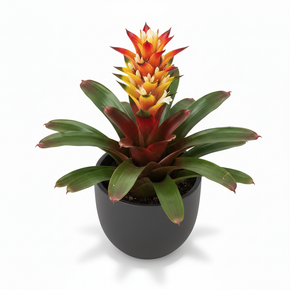
Bring instant tropical style to your space with Guzmania lingulata. Its vivid red center and glossy green rosette look designer-fresh for weeks, while the care routine stays simple: bright indirect light, refresh the center cup weekly, and water the soil lightly. A standout choice for modern homes, offices, and gifting.
Common Name: Scarlet Star, Guzmania
Botanical Name: Guzmania lingulata
Arabic Name: غوزمانيا
Family: Bromeliaceae
Kingdom: Plantae
Clade: Monocots
Order: Poales
Family: Bromeliaceae
Genus: Guzmania
Species: G. lingulata
Guzmania lingulata is native to the tropical rainforests of Central America, South America, and the Caribbean. In its natural habitat, it often grows as an epiphyte on trees, drawing moisture and nutrients from the air and rain.
This plant features a star-shaped rosette of smooth, glossy green leaves. The most striking feature is the central inflorescence composed of brilliant red or orange bracts that remain vibrant for several months, protecting small, short-lived yellow or white flowers.
Typically reaches a height of 12 to 18 inches (30-45 cm) and a width of approximately 12 to 24 inches (30-60 cm) at maturity.
Thrives in bright, indirect light. It can tolerate lower light levels, but its colors will be less vibrant. Avoid direct midday sun, which can scorch the foliage.
Unique among houseplants, it should be watered by filling the central "cup" formed by its leaves. The water in the cup should be emptied and replaced weekly to prevent rot. Keep the soil slightly moist but never waterlogged.
Requires a very well-draining, porous potting mix. A specialized bromeliad mix, orchid bark, or a combination of peat moss and perlite is ideal to prevent root rot.
Prefers warm temperatures between 65°F and 80°F (18°C - 27°C). It thrives in high humidity environments; frequent misting or the use of a humidifier is recommended in dry indoor settings.
Use a balanced, water-soluble fertilizer diluted to half-strength once a month during the growing season. Apply to the soil and foliage, but avoid adding fertilizer to the central cup.
Maintenance is low. The main plant will eventually die after blooming, which is a natural part of its life cycle. However, it will produce new "pups" or offsets at the base before it fades.
Propagation is achieved by removing the offsets (pups) that appear at the base of the parent plant. These can be potted individually once they are about one-third the size of the mother plant.
The most common issues include root rot from overwatering the soil and salt or mineral buildup in the central cup. Brown leaf tips can indicate low humidity or the use of hard water.
Recognized for its air-purifying qualities, it helps remove indoor pollutants like formaldehyde. Its long-lasting color makes it a favorite for interior design, office desks, and as an ornamental gift.
Guzmania lingulata is considered non-toxic to humans, cats, and dogs, making it a safe addition to any pet-friendly household.
Bring instant tropical style to your space with Guzmania lingulata. Its vivid red center and glossy green rosette look designer-fresh for weeks, while the care routine stays simple: bright indirect light, refresh the center cup weekly, and water the soil lightly. A standout choice for modern homes, offices, and gifting.
Common Name: Scarlet Star, Guzmania
Botanical Name: Guzmania lingulata
Arabic Name: غوزمانيا
Family: Bromeliaceae
Kingdom: Plantae
Clade: Monocots
Order: Poales
Family: Bromeliaceae
Genus: Guzmania
Species: G. lingulata
Guzmania lingulata is native to the tropical rainforests of Central America, South America, and the Caribbean. In its natural habitat, it often grows as an epiphyte on trees, drawing moisture and nutrients from the air and rain.
This plant features a star-shaped rosette of smooth, glossy green leaves. The most striking feature is the central inflorescence composed of brilliant red or orange bracts that remain vibrant for several months, protecting small, short-lived yellow or white flowers.
Typically reaches a height of 12 to 18 inches (30-45 cm) and a width of approximately 12 to 24 inches (30-60 cm) at maturity.
Thrives in bright, indirect light. It can tolerate lower light levels, but its colors will be less vibrant. Avoid direct midday sun, which can scorch the foliage.
Unique among houseplants, it should be watered by filling the central "cup" formed by its leaves. The water in the cup should be emptied and replaced weekly to prevent rot. Keep the soil slightly moist but never waterlogged.
Requires a very well-draining, porous potting mix. A specialized bromeliad mix, orchid bark, or a combination of peat moss and perlite is ideal to prevent root rot.
Prefers warm temperatures between 65°F and 80°F (18°C - 27°C). It thrives in high humidity environments; frequent misting or the use of a humidifier is recommended in dry indoor settings.
Use a balanced, water-soluble fertilizer diluted to half-strength once a month during the growing season. Apply to the soil and foliage, but avoid adding fertilizer to the central cup.
Maintenance is low. The main plant will eventually die after blooming, which is a natural part of its life cycle. However, it will produce new "pups" or offsets at the base before it fades.
Propagation is achieved by removing the offsets (pups) that appear at the base of the parent plant. These can be potted individually once they are about one-third the size of the mother plant.
The most common issues include root rot from overwatering the soil and salt or mineral buildup in the central cup. Brown leaf tips can indicate low humidity or the use of hard water.
Recognized for its air-purifying qualities, it helps remove indoor pollutants like formaldehyde. Its long-lasting color makes it a favorite for interior design, office desks, and as an ornamental gift.
Guzmania lingulata is considered non-toxic to humans, cats, and dogs, making it a safe addition to any pet-friendly household.




Take 20% off your first order
Enter the code below at checkout to get 20% off your first order