


Araliaceae
Schefflera arboricola
Bring instant tropical volume to your space with Schefflera arboricola. Its glossy, umbrella-like leaves and full canopy make it a premium statement plant for living rooms, receptions, and meeting areas. Easy to maintain, forgiving, and beautifully shapeable with light pruning—this Aralia is the go-to choice for stylish greenery with minimal effort.
1. Basic Identification
Common Name: Dwarf Umbrella Tree, Aralia, اراليا
Botanical Name: Schefflera arboricola
Variant: Standard
Plant Color: Colored
Plant Country: Netherlands
Stems: 7
2. Taxonomy & Classification
Kingdom: Plantae
Clade: Tracheophytes
Order: Apiales
Family: Araliaceae
Genus: Schefflera
Species: Schefflera arboricola
3. Origin & Distribution
Native to Taiwan and Hainan Island, China. It is widely cultivated globally as a popular ornamental houseplant and outdoor landscape shrub in tropical and subtropical climates.
4. Visual Characteristics
Features glossy, palmate (umbrella-shaped) leaves that grow in clusters. Each leaf typically consists of 7 to 9 leaflets. The "Standard" variant maintains a lush, bushy appearance with multiple stems that create a dense canopy of green or variegated foliage.
5. Size & Dimensions
Indoors, it typically grows to a height of 1 to 3 meters (3-10 feet). It can be easily maintained at a specific size through regular pruning and is categorized as a medium-sized plant.
6. Light Requirements
Prefers bright, indirect light but is highly adaptable. It can tolerate lower light conditions, though growth may slow and the plant may become leggy. Avoid direct midday sun, which can scorch the leaves.
7. Watering Needs
Water when the top 2-3 cm of soil has dried out. It is relatively drought-tolerant but sensitive to overwatering, which can lead to root rot. Ensure the pot has excellent drainage.
8. Soil & Potting
Requires a well-draining potting mix, ideally a peat-based or coco-coir based mixture with added perlite or bark to ensure aeration and drainage.
9. Temperature & Humidity
Thrives in temperatures between 15°C and 24°C (60°F-75°F). It appreciates moderate to high humidity; if the air is very dry, occasional misting or a pebble tray may be beneficial.
10. Fertilization
Feed with a balanced liquid fertilizer once a month during the growing season (spring and summer). Reduce feeding in the autumn and winter months.
11. Maintenance & Care Level
Care Level: Easy. It is a hardy and forgiving plant. Periodic pruning is recommended to maintain its shape and encourage bushier growth. Wipe the leaves with a damp cloth occasionally to remove dust.
12. Growth & Propagation
Moderate growth rate. It can be propagated relatively easily via stem cuttings or air layering during the spring and summer months.
13. Common Problems
Susceptible to common houseplant pests such as spider mites, scale, and aphids. Leaf drop can occur if the plant is moved suddenly or if it experiences significant temperature fluctuations or overwatering.
14. Benefits & Uses
Recognized for its air-purifying qualities, it helps remove indoor toxins like benzene, formaldehyde, and toluene. It is ideal for home décor, office spaces, and receptions due to its aesthetic "tropical" look.
15. Toxicity & Safety
Toxic to cats, dogs, and humans if ingested. The plant contains calcium oxalate crystals, which can cause oral irritation, drooling, vomiting, and difficulty swallowing.
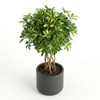
Schefflera arboricola

Bring instant tropical volume to your space with Schefflera arboricola. Its glossy, umbrella-like leaves and full canopy make it a premium statement plant for living rooms, receptions, and meeting areas. Easy to maintain, forgiving, and beautifully shapeable with light pruning—this Aralia is the go-to choice for stylish greenery with minimal effort.
1. Basic Identification
Common Name: Dwarf Umbrella Tree, Aralia, اراليا
Botanical Name: Schefflera arboricola
Variant: Standard
Plant Color: Colored
Plant Country: Netherlands
Stems: 7
2. Taxonomy & Classification
Kingdom: Plantae
Clade: Tracheophytes
Order: Apiales
Family: Araliaceae
Genus: Schefflera
Species: Schefflera arboricola
3. Origin & Distribution
Native to Taiwan and Hainan Island, China. It is widely cultivated globally as a popular ornamental houseplant and outdoor landscape shrub in tropical and subtropical climates.
4. Visual Characteristics
Features glossy, palmate (umbrella-shaped) leaves that grow in clusters. Each leaf typically consists of 7 to 9 leaflets. The "Standard" variant maintains a lush, bushy appearance with multiple stems that create a dense canopy of green or variegated foliage.
5. Size & Dimensions
Indoors, it typically grows to a height of 1 to 3 meters (3-10 feet). It can be easily maintained at a specific size through regular pruning and is categorized as a medium-sized plant.
6. Light Requirements
Prefers bright, indirect light but is highly adaptable. It can tolerate lower light conditions, though growth may slow and the plant may become leggy. Avoid direct midday sun, which can scorch the leaves.
7. Watering Needs
Water when the top 2-3 cm of soil has dried out. It is relatively drought-tolerant but sensitive to overwatering, which can lead to root rot. Ensure the pot has excellent drainage.
8. Soil & Potting
Requires a well-draining potting mix, ideally a peat-based or coco-coir based mixture with added perlite or bark to ensure aeration and drainage.
9. Temperature & Humidity
Thrives in temperatures between 15°C and 24°C (60°F-75°F). It appreciates moderate to high humidity; if the air is very dry, occasional misting or a pebble tray may be beneficial.
10. Fertilization
Feed with a balanced liquid fertilizer once a month during the growing season (spring and summer). Reduce feeding in the autumn and winter months.
11. Maintenance & Care Level
Care Level: Easy. It is a hardy and forgiving plant. Periodic pruning is recommended to maintain its shape and encourage bushier growth. Wipe the leaves with a damp cloth occasionally to remove dust.
12. Growth & Propagation
Moderate growth rate. It can be propagated relatively easily via stem cuttings or air layering during the spring and summer months.
13. Common Problems
Susceptible to common houseplant pests such as spider mites, scale, and aphids. Leaf drop can occur if the plant is moved suddenly or if it experiences significant temperature fluctuations or overwatering.
14. Benefits & Uses
Recognized for its air-purifying qualities, it helps remove indoor toxins like benzene, formaldehyde, and toluene. It is ideal for home décor, office spaces, and receptions due to its aesthetic "tropical" look.
15. Toxicity & Safety
Toxic to cats, dogs, and humans if ingested. The plant contains calcium oxalate crystals, which can cause oral irritation, drooling, vomiting, and difficulty swallowing.