

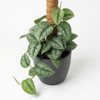



Turn any corner into a lush statement with Satin Pothos. Its velvety leaves shimmer with silver splashes, instantly upgrading shelves, desks, and receptions. Train it vertically for a bold “green wall” look or let it cascade for effortless elegance—minimal care, maximum impact.
Common Name: Satin Pothos
Botanical Name: Scindapsus pictus
Former Name: Epipremnum pictum (syn.)
Plant Type: Foliage houseplant (Aroid vine)
Plant Code / SKU: PLT-0434
Alternative Names:
Silver Pothos
Silver Vine
Satin Vine
Pothos pictus
لبلاب
Order: Alismatales
Family: Araceae
Genus: Scindapsus
Species: pictus
Native to the tropical rainforests of Southeast Asia, including Borneo, Sumatra, and Java. Widely cultivated as an ornamental houseplant in homes and offices worldwide.
Evergreen perennial vine with soft, velvety, heart-shaped leaves measuring 6–12 cm long and 4–8 cm wide. Foliage is dark green with distinctive silver-gray splotches and variegation. Stems are slender and climb via aerial roots; can be trained to climb supports or allowed to trail.
Indoors, vines can reach 1–2 m in length when supported. Leaves typically span 6–12 cm in length. Recommended pot sizes range from 10–15 cm in diameter; repot to the next size every 1–2 years to accommodate root growth.
Requires bright, indirect light for optimal growth and variegation. Tolerates moderate light but will exhibit slower growth and reduced variegation in low-light conditions. Avoid direct midday sun to prevent leaf scorch.
Water when the top 2–3 cm of soil feels dry to the touch. Maintain even moisture during the active growing season; reduce watering frequency in winter. Ensure excess water drains freely to prevent root rot.
Use a well-draining potting mix rich in organic matter, such as a blend of peat moss, perlite, and orchid bark or coarse sand. Aim for a pH of 6.1–7.3. Always select a pot with adequate drainage holes.
Thrives in temperatures between 18–29 °C. Avoid exposure to temperatures below 15 °C. Prefers high humidity levels of 60–80%; increase humidity with regular misting, a pebble tray, or a humidifier.
Feed with a balanced liquid fertilizer (e.g., 10-10-10 NPK) diluted to half strength every 4–6 weeks during spring and summer. Suspend fertilization in fall and winter when growth slows.
Care level: Easy to moderate. Prune regularly to maintain desired shape and remove leggy or damaged growth. Wipe leaves occasionally to remove dust and improve light absorption. Monitor for common pests.
Propagation is typically by stem cuttings containing at least one node. Place cuttings in water or directly into moist potting mix until roots develop (2–4 weeks). Use a moss pole or trellis to encourage vertical growth.
Overwatering can cause yellowing leaves and root rot. Underwatering leads to leaf curling and brown margins. Direct sunlight may result in leaf burn. Pests to watch for include spider mites, mealybugs, and scale.
Effective at removing indoor air pollutants such as formaldehyde. Its attractive trailing or climbing habit makes it ideal for hanging baskets, shelves, and green walls. Adds a lush, decorative accent to homes, offices, and reception areas.
Contains calcium oxalate crystals; toxic to pets and humans if ingested. Can cause oral irritation, drooling, difficulty swallowing, and vomiting. Keep out of reach of children and animals.
Turn any corner into a lush statement with Satin Pothos. Its velvety leaves shimmer with silver splashes, instantly upgrading shelves, desks, and receptions. Train it vertically for a bold “green wall” look or let it cascade for effortless elegance—minimal care, maximum impact.
Common Name: Satin Pothos
Botanical Name: Scindapsus pictus
Former Name: Epipremnum pictum (syn.)
Plant Type: Foliage houseplant (Aroid vine)
Plant Code / SKU: PLT-0434
Alternative Names:
Silver Pothos
Silver Vine
Satin Vine
Pothos pictus
لبلاب
Order: Alismatales
Family: Araceae
Genus: Scindapsus
Species: pictus
Native to the tropical rainforests of Southeast Asia, including Borneo, Sumatra, and Java. Widely cultivated as an ornamental houseplant in homes and offices worldwide.
Evergreen perennial vine with soft, velvety, heart-shaped leaves measuring 6–12 cm long and 4–8 cm wide. Foliage is dark green with distinctive silver-gray splotches and variegation. Stems are slender and climb via aerial roots; can be trained to climb supports or allowed to trail.
Indoors, vines can reach 1–2 m in length when supported. Leaves typically span 6–12 cm in length. Recommended pot sizes range from 10–15 cm in diameter; repot to the next size every 1–2 years to accommodate root growth.
Requires bright, indirect light for optimal growth and variegation. Tolerates moderate light but will exhibit slower growth and reduced variegation in low-light conditions. Avoid direct midday sun to prevent leaf scorch.
Water when the top 2–3 cm of soil feels dry to the touch. Maintain even moisture during the active growing season; reduce watering frequency in winter. Ensure excess water drains freely to prevent root rot.
Use a well-draining potting mix rich in organic matter, such as a blend of peat moss, perlite, and orchid bark or coarse sand. Aim for a pH of 6.1–7.3. Always select a pot with adequate drainage holes.
Thrives in temperatures between 18–29 °C. Avoid exposure to temperatures below 15 °C. Prefers high humidity levels of 60–80%; increase humidity with regular misting, a pebble tray, or a humidifier.
Feed with a balanced liquid fertilizer (e.g., 10-10-10 NPK) diluted to half strength every 4–6 weeks during spring and summer. Suspend fertilization in fall and winter when growth slows.
Care level: Easy to moderate. Prune regularly to maintain desired shape and remove leggy or damaged growth. Wipe leaves occasionally to remove dust and improve light absorption. Monitor for common pests.
Propagation is typically by stem cuttings containing at least one node. Place cuttings in water or directly into moist potting mix until roots develop (2–4 weeks). Use a moss pole or trellis to encourage vertical growth.
Overwatering can cause yellowing leaves and root rot. Underwatering leads to leaf curling and brown margins. Direct sunlight may result in leaf burn. Pests to watch for include spider mites, mealybugs, and scale.
Effective at removing indoor air pollutants such as formaldehyde. Its attractive trailing or climbing habit makes it ideal for hanging baskets, shelves, and green walls. Adds a lush, decorative accent to homes, offices, and reception areas.
Contains calcium oxalate crystals; toxic to pets and humans if ingested. Can cause oral irritation, drooling, difficulty swallowing, and vomiting. Keep out of reach of children and animals.

Take 20% off your first order
Enter the code below at checkout to get 20% off your first order