


Snake Plant 'Trifasciata'
Meet the indestructible Snake Plant, the perfect green companion for any home or office. Renowned for its air-purifying qualities and striking architectural foliage, this Dracaena trifasciata is the epitome of 'set it and forget it' plant care. It thrives in low light and tolerates neglect, making it an ideal choice for busy individuals and beginners alike. Elevate your space with its bold, modern aesthetic while it works silently to clean your air.
1. Basic Identification
Common Name: Snake Plant, Mother-in-Law’s Tongue
Botanical Name: Dracaena trifasciata
Variant: Trifasciata
Color: Multicolor (Green with grey-green banding and occasionally yellow margins)
Country of Origin: Netherlands
Arabic Name: دراسينيا
2. Taxonomy & Classification
Kingdom: Plantae
Clade: Tracheophytes
Order: Asparagales
Family: Asparagaceae
Genus: Dracaena
Species: D. trifasciata
3. Origin & Distribution
Native to tropical West Africa, specifically from Nigeria east to the Congo. It has been naturalized in many tropical regions worldwide and is one of the most popular indoor plants globally.
4. Visual Characteristics
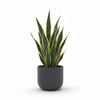
This plant features stiff, sword-like leaves that grow vertically from a basal rosette. The leaves are typically dark green with horizontal light gray-green banding. The foliage is thick, succulent, and ends in a sharp point.
5. Size & Dimensions
Indoors, the Trifasciata variant typically reaches a height of 1 to 3 feet (30–90 cm). Individual leaves can grow up to 2.5 inches wide.
6. Light Requirements
Very adaptable. It thrives in bright indirect light but is famously tolerant of low light conditions. It can also handle some direct morning sunlight, though harsh afternoon sun may scorch the leaves.
7. Watering Needs
Low watering needs. Allow the soil to dry out completely between waterings. In winter, watering once a month is often sufficient. Avoid getting water into the center of the rosette as it may cause rot.
8. Soil & Potting
Requires a well-draining potting mix, such as a cactus or succulent soil blend. It prefers being slightly root-bound and should be kept in a pot with adequate drainage holes.
9. Temperature & Humidity
Thrives in standard household temperatures between 60°F and 80°F (15°C–27°C). It is highly tolerant of dry air and does not require supplemental humidity.
10. Fertilization
Requires very little fertilizer. Feed with a balanced, all-purpose liquid houseplant fertilizer diluted to half-strength once in the spring and once in the summer.
11. Maintenance & Care Level
Level: Very Easy. Maintenance involves occasionally wiping the leaves with a damp cloth to remove dust and cutting away any dead or damaged leaves at the base.
12. Growth & Propagation
Growth rate is slow to moderate. It can be easily propagated through leaf cuttings (though variegation may be lost) or by dividing the rhizomes during repotting.
13. Common Problems
The most common issue is root rot caused by overwatering. It can occasionally suffer from mealybugs or spider mites, but it is generally pest-resistant.
14. Benefits & Uses
Highly effective at removing indoor air toxins such as formaldehyde, benzene, and xylene. Uniquely, it converts CO2 into oxygen at night, making it an excellent plant for bedrooms. Its architectural shape makes it a favorite for modern interior design.
15. Toxicity & Safety
Mildly toxic to cats and dogs if ingested. Contains saponins which can cause nausea, vomiting, and diarrhea in pets.
Snake Plant 'Trifasciata'

Meet the indestructible Snake Plant, the perfect green companion for any home or office. Renowned for its air-purifying qualities and striking architectural foliage, this Dracaena trifasciata is the epitome of 'set it and forget it' plant care. It thrives in low light and tolerates neglect, making it an ideal choice for busy individuals and beginners alike. Elevate your space with its bold, modern aesthetic while it works silently to clean your air.
1. Basic Identification
Common Name: Snake Plant, Mother-in-Law’s Tongue
Botanical Name: Dracaena trifasciata
Variant: Trifasciata
Color: Multicolor (Green with grey-green banding and occasionally yellow margins)
Country of Origin: Netherlands
Arabic Name: دراسينيا
2. Taxonomy & Classification
Kingdom: Plantae
Clade: Tracheophytes
Order: Asparagales
Family: Asparagaceae
Genus: Dracaena
Species: D. trifasciata
3. Origin & Distribution
Native to tropical West Africa, specifically from Nigeria east to the Congo. It has been naturalized in many tropical regions worldwide and is one of the most popular indoor plants globally.
4. Visual Characteristics
This plant features stiff, sword-like leaves that grow vertically from a basal rosette. The leaves are typically dark green with horizontal light gray-green banding. The foliage is thick, succulent, and ends in a sharp point.
5. Size & Dimensions
Indoors, the Trifasciata variant typically reaches a height of 1 to 3 feet (30–90 cm). Individual leaves can grow up to 2.5 inches wide.
6. Light Requirements
Very adaptable. It thrives in bright indirect light but is famously tolerant of low light conditions. It can also handle some direct morning sunlight, though harsh afternoon sun may scorch the leaves.
7. Watering Needs
Low watering needs. Allow the soil to dry out completely between waterings. In winter, watering once a month is often sufficient. Avoid getting water into the center of the rosette as it may cause rot.
8. Soil & Potting
Requires a well-draining potting mix, such as a cactus or succulent soil blend. It prefers being slightly root-bound and should be kept in a pot with adequate drainage holes.
9. Temperature & Humidity
Thrives in standard household temperatures between 60°F and 80°F (15°C–27°C). It is highly tolerant of dry air and does not require supplemental humidity.
10. Fertilization
Requires very little fertilizer. Feed with a balanced, all-purpose liquid houseplant fertilizer diluted to half-strength once in the spring and once in the summer.
11. Maintenance & Care Level
Level: Very Easy. Maintenance involves occasionally wiping the leaves with a damp cloth to remove dust and cutting away any dead or damaged leaves at the base.
12. Growth & Propagation
Growth rate is slow to moderate. It can be easily propagated through leaf cuttings (though variegation may be lost) or by dividing the rhizomes during repotting.
13. Common Problems
The most common issue is root rot caused by overwatering. It can occasionally suffer from mealybugs or spider mites, but it is generally pest-resistant.
14. Benefits & Uses
Highly effective at removing indoor air toxins such as formaldehyde, benzene, and xylene. Uniquely, it converts CO2 into oxygen at night, making it an excellent plant for bedrooms. Its architectural shape makes it a favorite for modern interior design.
15. Toxicity & Safety
Mildly toxic to cats and dogs if ingested. Contains saponins which can cause nausea, vomiting, and diarrhea in pets.