


Standard Arborvitae 'Standard Topiary'
Create an instant statement of elegance with our Standard Arborvitae Topiary. Perfectly manicured into a timeless 'lollipop' shape, this Thuja tree brings a touch of formal sophistication to any entrance, patio, or garden design. As a hardy evergreen, it promises lush, green beauty all year long with minimal fuss. It's not just a plant; it's living architecture. Order yours today and define your space with classic style.
1. Basic Identification
Common Name: Arborvitae, White Cedar
Botanical Name: Thuja occidentalis
Plant Variant: Standard Topiary
Plant Color: Green
Plant Country: Netherlands
Arabic Name: ثويا
Family: Cupressaceae
2. Taxonomy & Classification
Kingdom: Plantae
Division: Pinophyta
Class: Pinopsida
Order: Pinales
Family: Cupressaceae
Genus: Thuja
Species: Thuja occidentalis
3. Origin & Distribution
Native to North America, primarily in Eastern Canada and the Northeastern and North-Central United States. It is widely cultivated across Europe, particularly in the Netherlands, for ornamental use.
4. Visual Characteristics
This evergreen features flat, fan-like sprays of scale-like foliage that remain green year-round. As a 'Standard Topiary', it has been professionally trained with a straight, slender trunk topped with a dense, rounded ball of foliage, creating a formal 'lollipop' silhouette.
5. Size & Dimensions
Typically maintained as a topiary at heights of 3 to 5 feet (90-150 cm). The spherical head of the foliage usually measures between 12 to 20 inches in diameter depending on the maturity and pruning style.
6. Light Requirements
Prefers full sun to partial shade. To maintain the density and vibrant green color of its foliage, it should receive at least 6 hours of direct sunlight daily.
7. Watering Needs
Requires regular watering to keep the soil consistently moist but not waterlogged. Topiary specimens in pots dry out faster and may need daily watering during hot summer months.
8. Soil & Potting
Thrives in well-drained, fertile, loamy soil. It is adaptable to various soil types, including slightly alkaline or acidic conditions, but requires good drainage to prevent root rot.
9. Temperature & Humidity
Highly cold-hardy and suitable for temperate climates. It can withstand freezing temperatures well. It prefers moderate humidity levels and should be protected from harsh, drying winter winds.
10. Fertilization
Apply a balanced, slow-release evergreen fertilizer once a year in early spring to support lush foliage growth and overall health.
11. Maintenance & Care Level
Moderate. While the plant is hardy, it requires regular shearing (1-2 times per year) to maintain its distinct lollipop topiary shape and prevent the foliage from becoming shaggy.
12. Growth & Propagation
A slow to moderate grower. In a topiary form, growth is controlled through pruning. Propagation is typically achieved via semi-hardwood cuttings taken in late summer.
13. Common Problems
Watch for spider mites, bagworms, and leaf miners. Browning of foliage can occur due to extreme drought, salt spray, or severe winter desiccation.
14. Benefits & Uses
Excellent for formal landscaping, framing doorways, and adding vertical interest to patios or balconies. It provides year-round architectural structure and is a favorite for classic garden designs.
15. Toxicity & Safety
Contains thujone, which can be toxic to pets (dogs, cats, and horses) if ingested in significant quantities. It is generally safe for humans to handle, though the foliage may cause mild skin irritation in sensitive individuals.
Standard Arborvitae 'Standard Topiary'
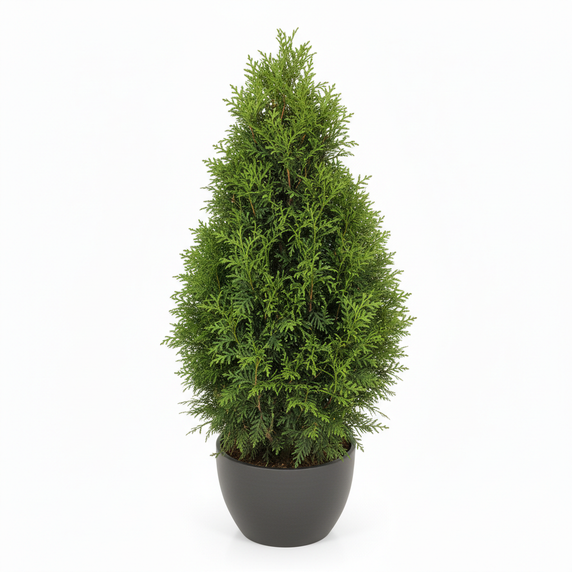
Create an instant statement of elegance with our Standard Arborvitae Topiary. Perfectly manicured into a timeless 'lollipop' shape, this Thuja tree brings a touch of formal sophistication to any entrance, patio, or garden design. As a hardy evergreen, it promises lush, green beauty all year long with minimal fuss. It's not just a plant; it's living architecture. Order yours today and define your space with classic style.
1. Basic Identification
Common Name: Arborvitae, White Cedar
Botanical Name: Thuja occidentalis
Plant Variant: Standard Topiary
Plant Color: Green
Plant Country: Netherlands
Arabic Name: ثويا
Family: Cupressaceae
2. Taxonomy & Classification
Kingdom: Plantae
Division: Pinophyta
Class: Pinopsida
Order: Pinales
Family: Cupressaceae
Genus: Thuja
Species: Thuja occidentalis
3. Origin & Distribution
Native to North America, primarily in Eastern Canada and the Northeastern and North-Central United States. It is widely cultivated across Europe, particularly in the Netherlands, for ornamental use.
4. Visual Characteristics
This evergreen features flat, fan-like sprays of scale-like foliage that remain green year-round. As a 'Standard Topiary', it has been professionally trained with a straight, slender trunk topped with a dense, rounded ball of foliage, creating a formal 'lollipop' silhouette.
5. Size & Dimensions
Typically maintained as a topiary at heights of 3 to 5 feet (90-150 cm). The spherical head of the foliage usually measures between 12 to 20 inches in diameter depending on the maturity and pruning style.
6. Light Requirements
Prefers full sun to partial shade. To maintain the density and vibrant green color of its foliage, it should receive at least 6 hours of direct sunlight daily.
7. Watering Needs
Requires regular watering to keep the soil consistently moist but not waterlogged. Topiary specimens in pots dry out faster and may need daily watering during hot summer months.
8. Soil & Potting
Thrives in well-drained, fertile, loamy soil. It is adaptable to various soil types, including slightly alkaline or acidic conditions, but requires good drainage to prevent root rot.
9. Temperature & Humidity
Highly cold-hardy and suitable for temperate climates. It can withstand freezing temperatures well. It prefers moderate humidity levels and should be protected from harsh, drying winter winds.
10. Fertilization
Apply a balanced, slow-release evergreen fertilizer once a year in early spring to support lush foliage growth and overall health.
11. Maintenance & Care Level
Moderate. While the plant is hardy, it requires regular shearing (1-2 times per year) to maintain its distinct lollipop topiary shape and prevent the foliage from becoming shaggy.
12. Growth & Propagation
A slow to moderate grower. In a topiary form, growth is controlled through pruning. Propagation is typically achieved via semi-hardwood cuttings taken in late summer.
13. Common Problems
Watch for spider mites, bagworms, and leaf miners. Browning of foliage can occur due to extreme drought, salt spray, or severe winter desiccation.
14. Benefits & Uses
Excellent for formal landscaping, framing doorways, and adding vertical interest to patios or balconies. It provides year-round architectural structure and is a favorite for classic garden designs.
15. Toxicity & Safety
Contains thujone, which can be toxic to pets (dogs, cats, and horses) if ingested in significant quantities. It is generally safe for humans to handle, though the foliage may cause mild skin irritation in sensitive individuals.